Follow us on Instagram (@slowdown.media) and subscribe to our weekly newsletter to receive behind-the-scenes updates and carefully curated musings.
TRANSCRIPT

Noah Horowitz. (Photo: Matthieu Croizier)
SPENCER BAILEY: Hi, Noah. Welcome to Time Sensitive.
NOAH HOROWITZ: Hey, Spencer. How are you?
SB: Doing well, really excited to have you here in the studio today.
We’re recording this interview on November 10th, 2025, which I guess in Art Basel time means it’s a few weeks before the 23rd edition of Art Basel Miami Beach, and just two weeks after the fourth edition of Art Basel Paris. And you’re now gearing up for the premiere of Art Basel Qatar, which will launch in February of next year. So, what’s your take on Art Basel time? How are you feeling at this moment in time?
NH: Yeah, so I joined the business, minus a hiatus at Sotheby’s. But I’ve been back in this role as CEO for three years, but I’ve been with the business effectively for ten years. In the beginning, there were three fairs. There was Basel, the mothership [in Switzerland] in June, and Miami, which is really the fair, not only the fair that I led, but the fair that I started coming to very early on. I didn’t go to the first edition, but I was living in London and grew up here, and it started in 2003. So, I’d come back, and pretty regularly—or rather, it started in 2002. I started attending it in 2003, but regularly attend that.
Then we had Hong Kong, but now with four in the first quarter next year, five fairs, there’s really no downtime anymore. I actually went straight from Paris two weeks ago to Doha for the Qatar Museums’ “Qatar Creates” week celebrating twenty years of Qatar Museums, and I’m back there already again next week for the Fashion Trust Arabia gala and all the stuff that Her Excellency Sheikha Al Mayassa [Bint Hamad Al-Thani] and the museum complex is doing out there. It’s extraordinary.
So, time is warp speed now, Spencer. [Laughter] But we always make sure to take pauses along the way and continuously recalibrate.
SB: Yeah, there is a certain slowness embedded in Art Basel somehow. I think we could make a case for that.
NH: Absolutely.
SB: We’re in Brooklyn right now, which isn’t far from your home [in Park Slope], so this is home base. But how often are you actually here?
NH: I’m on the road about half the time. I lead our business globally out of New York. We have an office of about twenty or so here downtown, which I opened about ten years ago—principally to service the Miami fair, but we work globally, so a lot of our colleagues in New York are servicing the business on a global basis. I’m in Basel every four to six weeks. I actually fly out this evening to Zurich, and will spend the rest of the week in Basel before coming back on the weekend. So it’s always switched on. But it’s nice to be with you in your extraordinary studio here, because it’s a Frida Escobedo project, right?
SB: SB: Yes. And this is where I reveal to the listeners this is the first time we’re recording in this new studio [inside Bergen Brooklyn]. It sounds good, feels good in here—it’s warm.
NH: I met Frida, I’ve kind of crisscrossed and I’m a huge fan of her work. We actually had dinner in Paris two weeks ago and we were seated opposite each other. I mean, she’s just a complete force. So, it’s really awesome to see and be inside a new building of hers, pretty much in my own backyard in Brooklyn here.
SB: Yeah. One of the things that I wanted to mention here, which I enjoyed in researching for this episode, was that you’ve described Art Basel as a “tight staccato of productions”—which sounds operatic, and I really like that. Maybe the idea of art-world opera.
[Laughter]
“We often compare the selection process for admission into the Art Basel fairs as tightening an orchestra. You need to get all the notes in order. Different galleries, different projects, different artists all play different notes.”
NH: I like that, as well—immensely, actually. Look, it is somewhat orchestral. I mean, we often compare the selection process for admission into the fairs as tightening an orchestra. You need to get all the notes in order. Different galleries, different projects, different artists all play different notes. And as we expand as a business and deliver more and more during these four—and very soon, five—times a year, but also come to life outside of those moments as well, that tight staccato is totally on point. It’s something that we are very focused on in terms of everything we do, every place that people in our audiences and clients have touchpoints with Art Basel need to be best in class.
One advantage to the insanity of delivering five events, [of] the caliber that we deliver—and I think that for those that were fortunate enough to be in Paris and the Grand Palais a few weeks ago really saw that in extraordinary form—is to debrief and to ask ourselves searching questions at each of these moments, coming out of these events, and then tighten and adjust for the next event and the next thing that we do after that. So that’s a bit chaotic from a management standpoint—it’s a lot—but it’s actually awesome, because it means that we’re learning more times a year than we used to. When I started in this business, in the art-fair business, in the bricks-and-mortar side of the art fair business, running The Armory Show all those years ago, you’d have this event in March and then [it] just fades away and then you’ve come together again a year after.
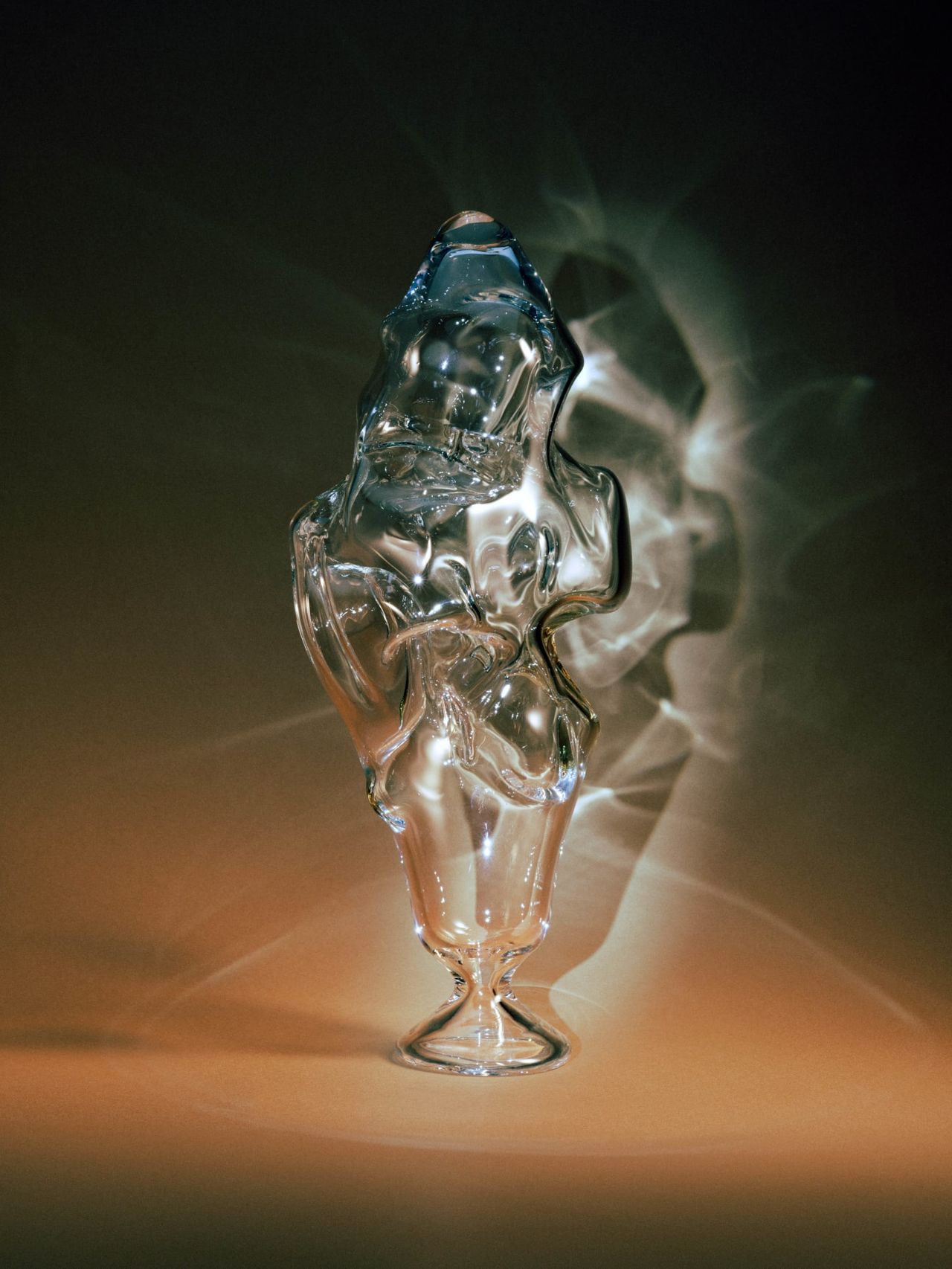
The Art Basel Awards trophy, designed by Jacques Herzog in collaboration with Glassworks Matteo Gonet. (Photo: Jessica Dreier/Courtesy Art Basel)
Now, with Art Basel, there’s really no downtime any longer. One of our goals is to be more and more present continuously, 365, through media, through editorial channels, through other events we’re running. Also, during the Paris week, we published with UBS the latest Survey of Global Collecting. We’re going to be rolling out the first edition of the Art Basel Awards’ Gold Medalist ceremony in Miami, which is a whole new crescendo to that show week. There’s a lot more coming across the platform now than there ever has been, and we are learning from different audience segments, different ways of delivering our business and brand than we ever have before.
SB: It’s so much more than an art fair. How would you define Art Basel? What would be a way of describing it? Because I think many of our listeners know what it is. Many of them attend Art Basel or have attended Art Basel, but it’s evolved so much since 1970, since it was this very selective, tight-knit fair in Basel, Switzerland. Now it’s something much, much larger.
NH: There are a few ways to think through this. First of all, we see ourselves as a leading cultural brand and, in doing that, the foremost objective is to continuously deliver for our gallery clients, for the artists that they represent, that they work with, but also for collecting communities, professional communities the world over. We have a mindset of continuously advancing opportunities, or being an opportunity accelerator, for the art world or the world of art writ large. This idea that we don’t directly—although increasingly more and more we’re commissioning more things—but, for a lot of what comes through the Art Basel platform, we don’t directly create it, but it comes through Art Basel and then it accelerates and explodes from there. And more opportunities whether commercially in terms of market making, but also in terms of advancing artist careers and creating more touchpoints for the global community of art.
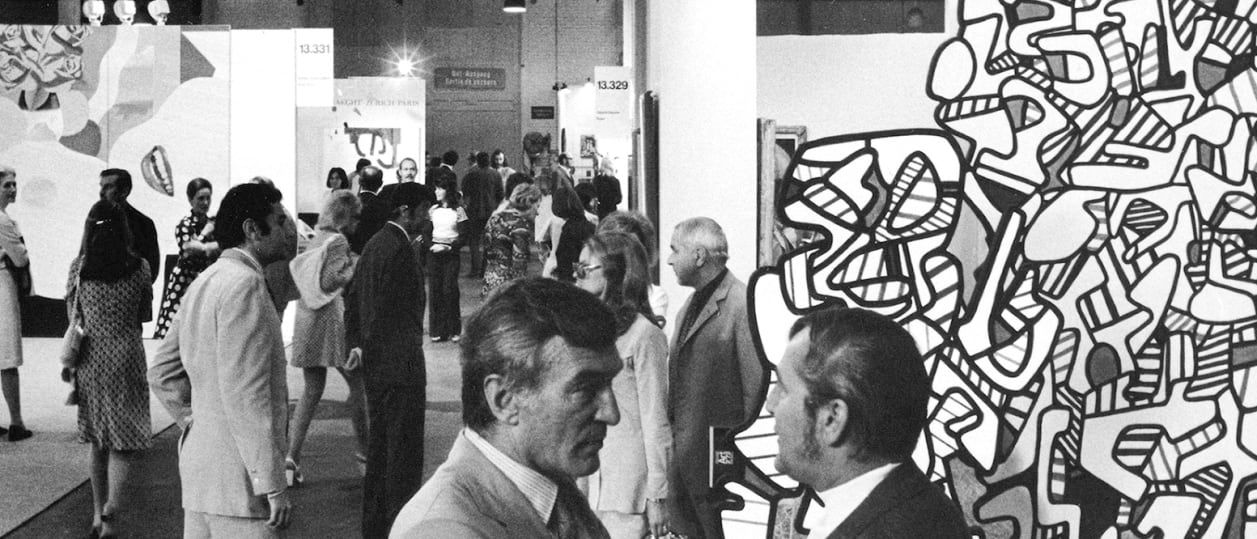
Art Basel’s inaugural 1970 fair in Basel, Switzerland. (Courtesy Art Basel)

Art Basel co-founder Ernst Beyeler in 1970. (Courtesy Art Basel)
If you go back to the beginning, in 1970, when Art Basel was founded by Ernst Beyeler, Trudl Bruckner, [and Balz Hilt] and a few others in Basel, Switzerland, it wasn’t the first art fair of its kind. I mean, Art Cologne famously was a few years ahead of it, but very quickly because of Beyeler’s imprimatur, it became a really important event. But even through the seventies into the eighties and nineties, there was Art Basel, there was Art Chicago, there were other regional fairs or media specific fairs. It wasn’t really until Miami where, in the early 2000s, Art Basel went from being basically like a trade fair for the trade to this event. So, the second chapter, in many ways, with Art Basel, was the “art fair week” and taking the apparatus of three walls, lights in an art fair booth, and expanding it into a program of V.I.P. events and film programming and music and all of this stuff that became synonymous with an art fair week.
Whilst we did that and continue to do that, it’s also been copied ad infinitum by other fairs and cultural get-togethers. I think with the addition of Hong Kong, Art Basel really expanded globally in a different way in terms of bringing the evolution of new opportunities, not just for the Western art world principally, but for a global art world. And that’s continued with Paris, which adds a different element within the European context. But interestingly, nowadays, it’s the most globally diverse of our fairs, as some of our attendance and some of the ebbs and flows of the business, perversely, have actually become more regionalized. Of course, with our foray into Qatar next year, that pushes the envelope even further into the MENA region, but also creating touchpoints to Central Asia, to Africa, so on and so forth. To your broader query about what Art Basel is, the reality is most people recognize the name: “What’s Art Basel? It’s cool. I’ve heard of it. I’ve been there.”
SB: Yeah, it’s an imprimatur kind of, it’s like a stamp, right?
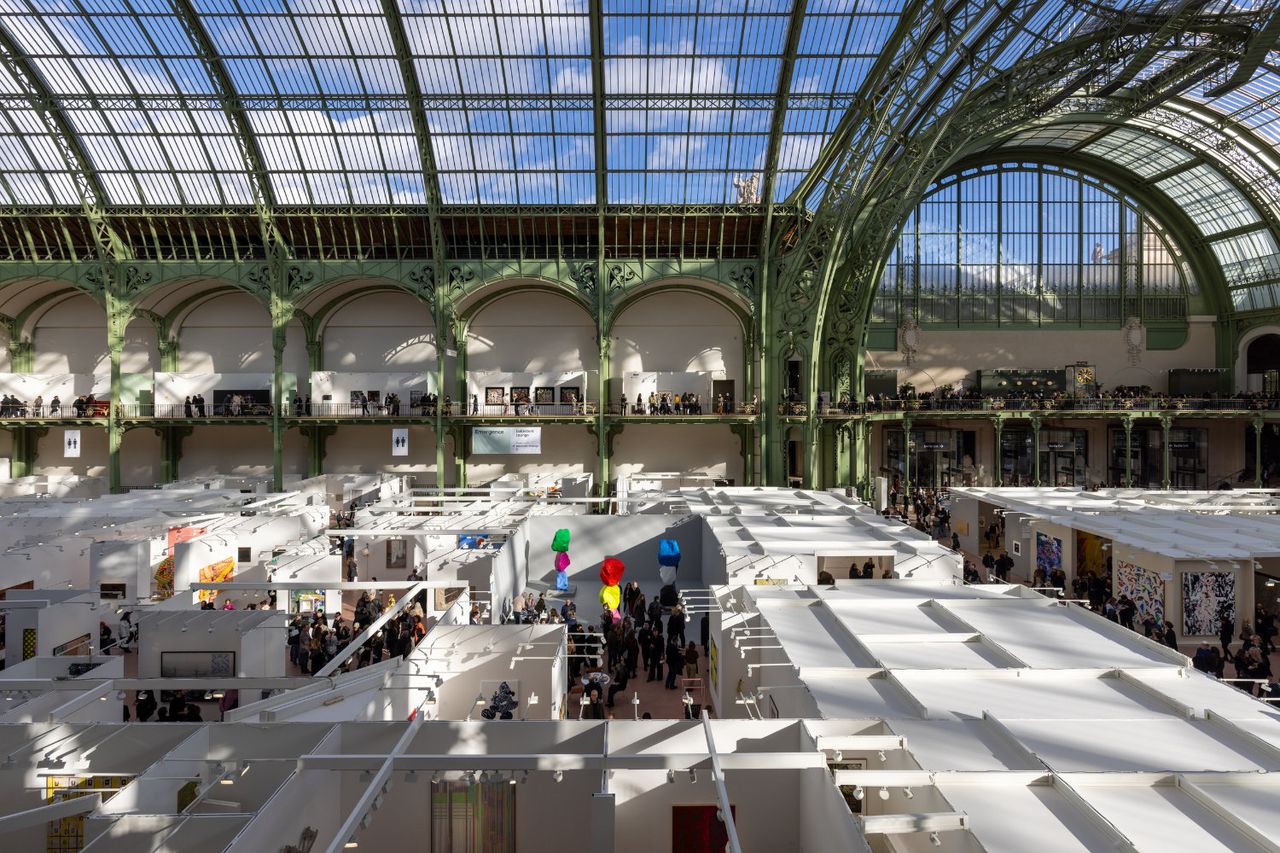
Art Basel Paris 2025. (Courtesy Art Basel)

Art Basel Paris 2025. (Courtesy Art Basel)
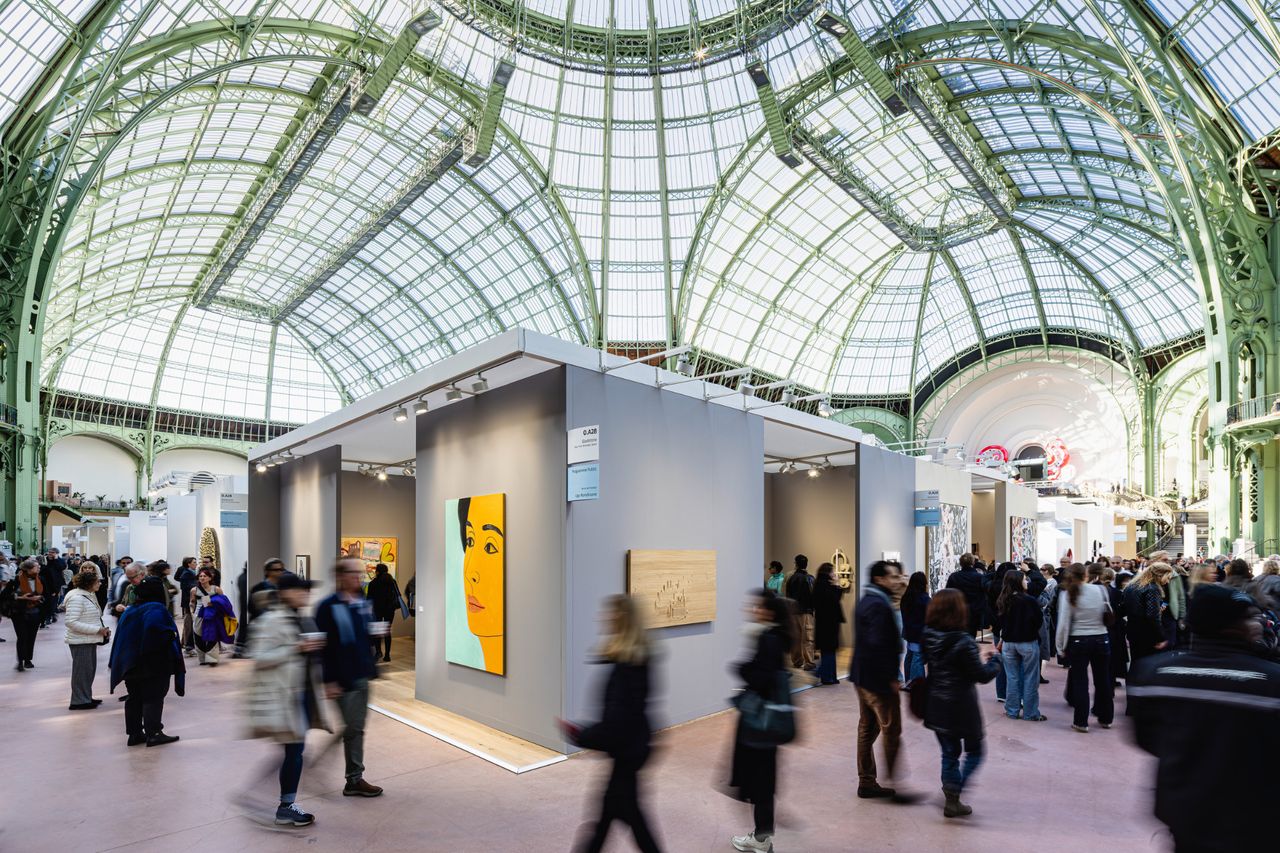
Art Basel Paris 2025. (Courtesy Art Basel)
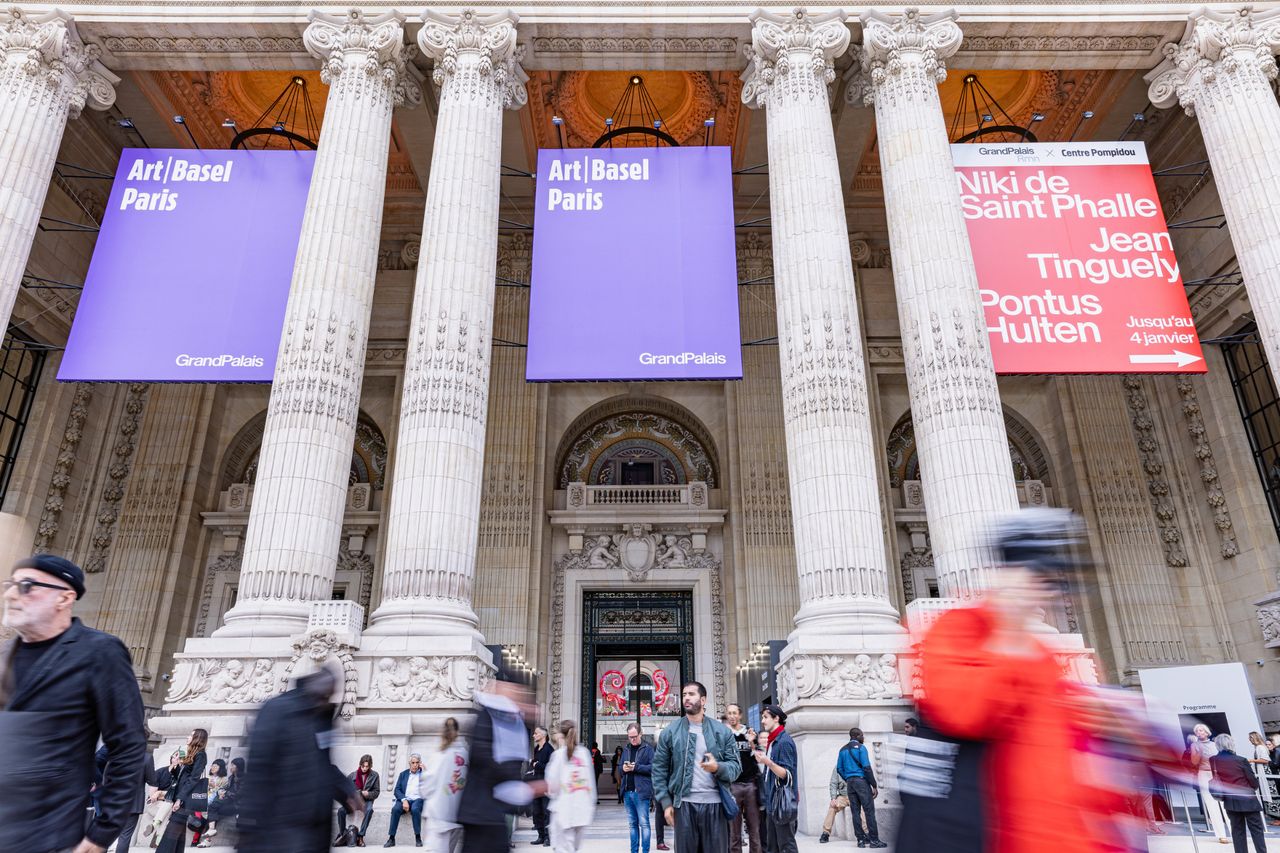
Art Basel Paris 2025. (Courtesy Art Basel)
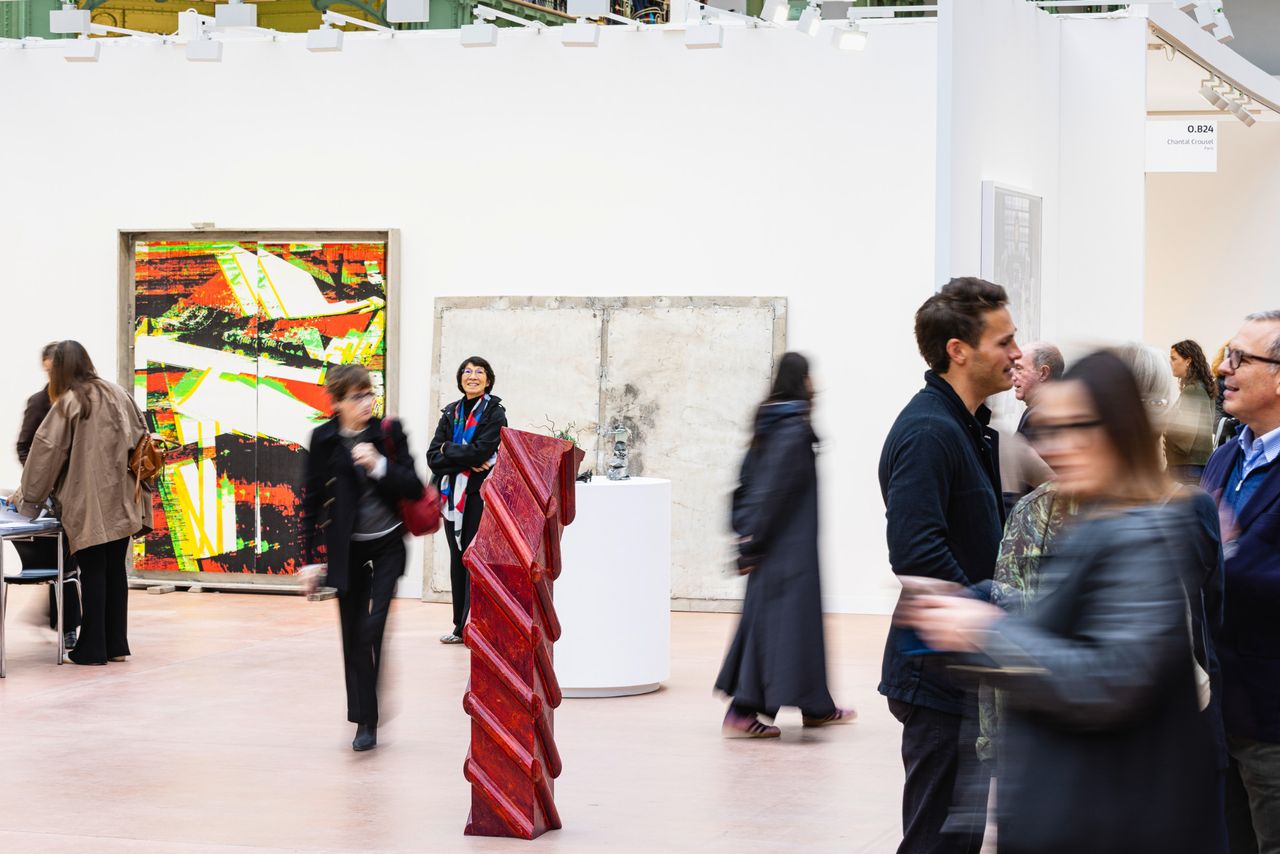
Art Basel Paris 2025. (Courtesy Art Basel)
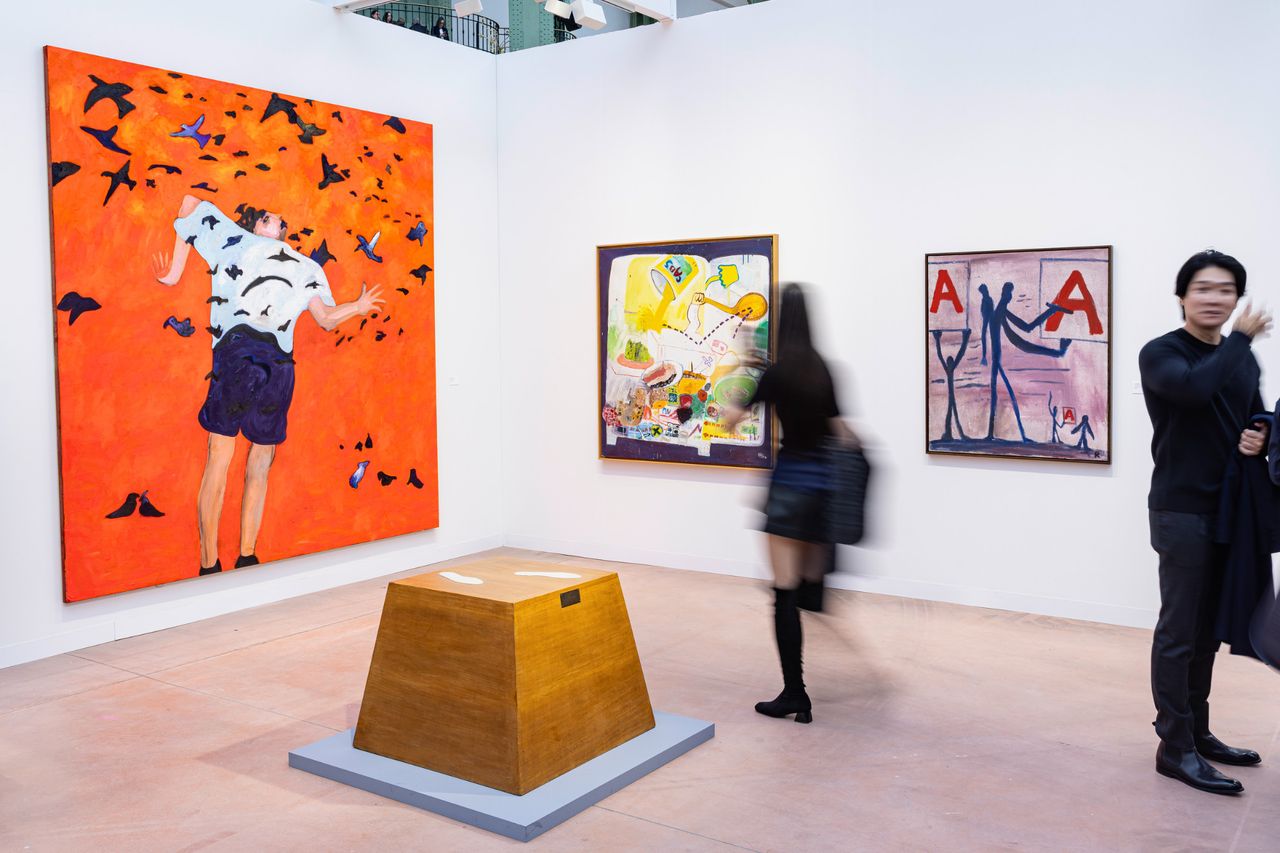
Art Basel Paris 2025. (Courtesy Art Basel)
Art Basel Paris 2025. (Courtesy Art Basel)
Art Basel Paris 2025. (Courtesy Art Basel)
Art Basel Paris 2025. (Courtesy Art Basel)
Art Basel Paris 2025. (Courtesy Art Basel)
Art Basel Paris 2025. (Courtesy Art Basel)
Art Basel Paris 2025. (Courtesy Art Basel)
Art Basel Paris 2025. (Courtesy Art Basel)
Art Basel Paris 2025. (Courtesy Art Basel)
Art Basel Paris 2025. (Courtesy Art Basel)
Art Basel Paris 2025. (Courtesy Art Basel)
Art Basel Paris 2025. (Courtesy Art Basel)
Art Basel Paris 2025. (Courtesy Art Basel)
“There’s this extremely high brand recognition, but actually pretty little operational understanding of what Art Basel is, and that’s a huge opportunity for us.”
NH: It’s a stamp of something. I don’t presuppose that actually most people actually know what Art Basel is. And I introduced you not long ago to our colleague John Nichols, who is a consultant and now the chief strategy and marketing officer of the business. We’ve been working with John and his consultancy over the last eighteen months to do a lot of insights and really listen to our audiences, and in surveying a lot of collecting, but also art-interested, audiences around Art Basel, one of the key takeaways was that the brand recognition of Art Basel is off the charts. Eighty to eighty-five percent of people that were surveyed globally that we created these touchpoints with knew Art Basel. It was familiar to them. But when you actually ask them what Art Basel is, that number—the funnel drops to twenty-five or thirty percent. So, there’s this extremely high brand recognition, but actually pretty little operational understanding of what Art Basel is, and that’s a huge opportunity for us.
One of the things that we’re very focused on now as a global brand is really correcting that name-recognition thing, really being much more intentional and clear about what Art Basel is as more and more people follow us through our social media channels, as they read about Art Basel, as they talk to friends or family or create touchpoints with people that come to Art Basel, but really try to very clearly message out to them what Art Basel is. I think even professionals—professionals within the trade get it—but many people that buy things that come to Art Basel show weeks, they don’t even know where Art Basel begins and ends. In the American context, we’re speaking in New York, like my broader network outside of the art world, they come to Basel in Miami—first of all, they don’t even know that Basel has a heritage in Switzerland. And when they say Basel, it’s synonymous with this extraordinary week of culture and goings-on in Miami. But many don’t realize or even clearly recognize the role we play in the business that we run, which is in the Miami Beach Convention Center and environs in the program.
There’s a lot of opportunity in that disconnect. And that’s one thing that we’re very focused on; [we’re] really, really focused on driving business to the great galleries, artists that come across our platform. I’m absolutely hell-bent on correcting perceptions around Art Basel’s read in the market. On the one hand, Art Basel stands for excellence, and it has to. The apex of a lot of that, of course, is seeing these extraordinary gems and masterpieces from the Western canon, but increasingly from throughout the world, whether the extraordinary Basquiats or some extraordinary Modiglianis and Richters, in the seven-, eight-figure price point.
But price isn’t in itself a measure of greatness, as I know you know and as I certainly know. Really good art and conceptual and aesthetic and structural contributions to the discourse around art are really what matters. And it’s important for our audiences to know that these things aren’t synonymous. We hope, and I hope as a CEO of the business, that art-loving audiences are able to come across Art Basel and really genuinely get curious down into the detail of what our clients bring and what artists do across the platform. That covers an infinitely wide spectrum of price points and touchpoints and access.
SB: Right. I like that you described it, in a certain sense, as an “incubator” or “accelerator”—kind of both. And there’s something that’s interesting that happens with time at an art fair. I feel like since we’re Time Sensitive here, we should be talking a little bit about this and probably no one better in the world to speak to about this than you. How do you think about what happens temporally within a fair itself? Because I do think that there’s sort of this condensed version of marketplace and reality that occurs within the walls of the Messeplatz or the Miami Beach Convention Center.
“Art Basel has this ability to both put its thumb on whatever’s hot and what’s in the moment, but also, given how far we stretch our wings and the depth of what one can experience in coming to an Art Basel fair, time also slows down.”
NH: Yeah. I love time as a precept. I think Art Basel as a real marker of where the market is has this ability to both put its thumb on whatever’s hot and what’s in the moment, but also, given how far we stretch our wings and the depth of what one can experience in coming to an Art Basel fair, time also slows down. The great joy that I have—and my team knows that I take this opportunity—is putting my headphones on and walking through the halls of the show very early on the mornings we open, by myself, checking out everything that our galleries bring, peeking into the closets, seeing the works that are sort of tucked away.
The fair as a beating mechanism has the ability to flex and adjust. It’s a bit of a choose-your-own-adventure. So, if you’re looking for the hottest and most interesting conceptual artist or best painter in Berlin or L.A., in all likelihood you’ll see that, and you’ll see the best examples of their work at Art Basel. But there are often also—and it’s beautiful that there are—these moments for reflection, rediscovery.
Increasingly in the market today, especially coming out of the cycle we’ve just churned through, as the market rebalances and recorrects, there’s some artists, as always in every cycle, that have been in the center of view and commanding extraordinary prices in the primary and secondary market. Not all of them will make it, but there are others that will be repositioned along the way. Discoveries, the trajectory around female surrealism, for example. Speaking of Frida [Escobedo], especially the Mexican canon is extraordinary right now—or the Latin American canon broadly—but there are artists from Southeast Asia that are being discovered and [being set] side by side against the Western greats. I think that’s beautiful.

Martine Aboucaya's presentation of Robert Barry’s “January-September, 1969" shown during Art Basel Paris 2025. (Courtesy Robert Barry and Martine Aboucaya)
In Paris, there were a number of these parallel streams running through, with a number of seminal works of Picasso from 1907, 1908, that Demoiselles d’Avignon period, works at the booth of Acquavella, like a 1908 masterpiece, and at Pace a 1907 masterpiece. And these are works that are millions or tens of millions of dollars. But then at the same time, upstairs [at the Grand Palais] in Paris, Martine Aboucaya did a beautiful conceptual project with Robert Barry [called “January–September, 1969”] with literally nothing in it. It was sort of repositioning his inert-gas series from the late sixties, early seventies. Or Taka Ishii, who is the master Japanese gallerist—and I know you love Japan—did a solo presentation, on the main floor, in the nave of Paris, maybe a hundred meters from where the biggest blue-chip galleries are dueling, and had a solo show of Rei Naito. Rei Naito is the famous—Teshima [Art] Museum as part of the Naoshima complex. And it’s awesome. It’s just, like—
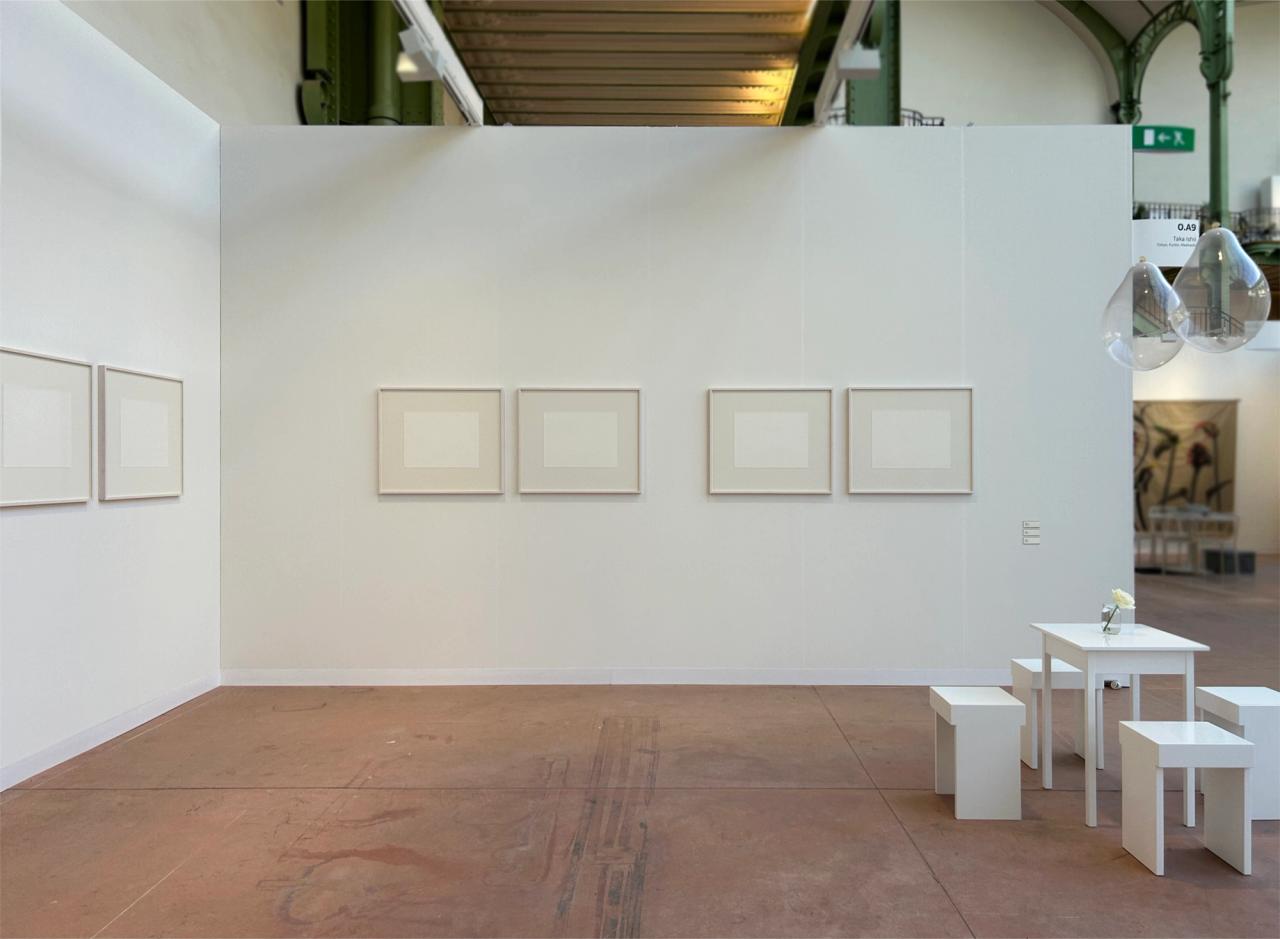
Taka Ishii Gallery’s presentation of Rei Naito’s “Two Lives” at Art Basel Paris 2025. (Courtesy Taka Ishii Gallery)
SB: Water droplets.
NH: Water droplets. There were two balloons, like Félix González-Torres’s [“Untitled (Perfect Lovers)” (1987-1990)] wall clocks. There was a little plant in a glass jar that— I saw this guy, it was the opening day of the fair, and I see this gallery assistant dropping a water beaker into it. The artwork only became an artwork when the water was totally leveled at the top, and then the drawings, there were drawings or maybe paintings or work on paper. They were like diptychs. They were absolutely unphotographable—you couldn’t possibly document them. And as a testament to slowing down time and the insane frenzy of an opening day of an Art Basel fair, it was like [makes kiss sound] this beautiful sort of kiss to what great art can be, but also what Art Basel as a platform can be, where you are able to see these artists side by side and the price differences and striation couldn’t be more jarring, as well.
SB: Putting us back in this moment in time that we’re in right now, heading into 2026, I wanted to bring up here that next year marks fifteen years since the publication of your book, The Art of the Deal, which is not to be confused with Donald Trump’s—
NH: It’s Art of the Deal. No “the” in the front, Spencer.
SB: Oh, okay, sorry. Gotcha.
NH: You can’t copyright a title. I need you to put “Art” center in that title.
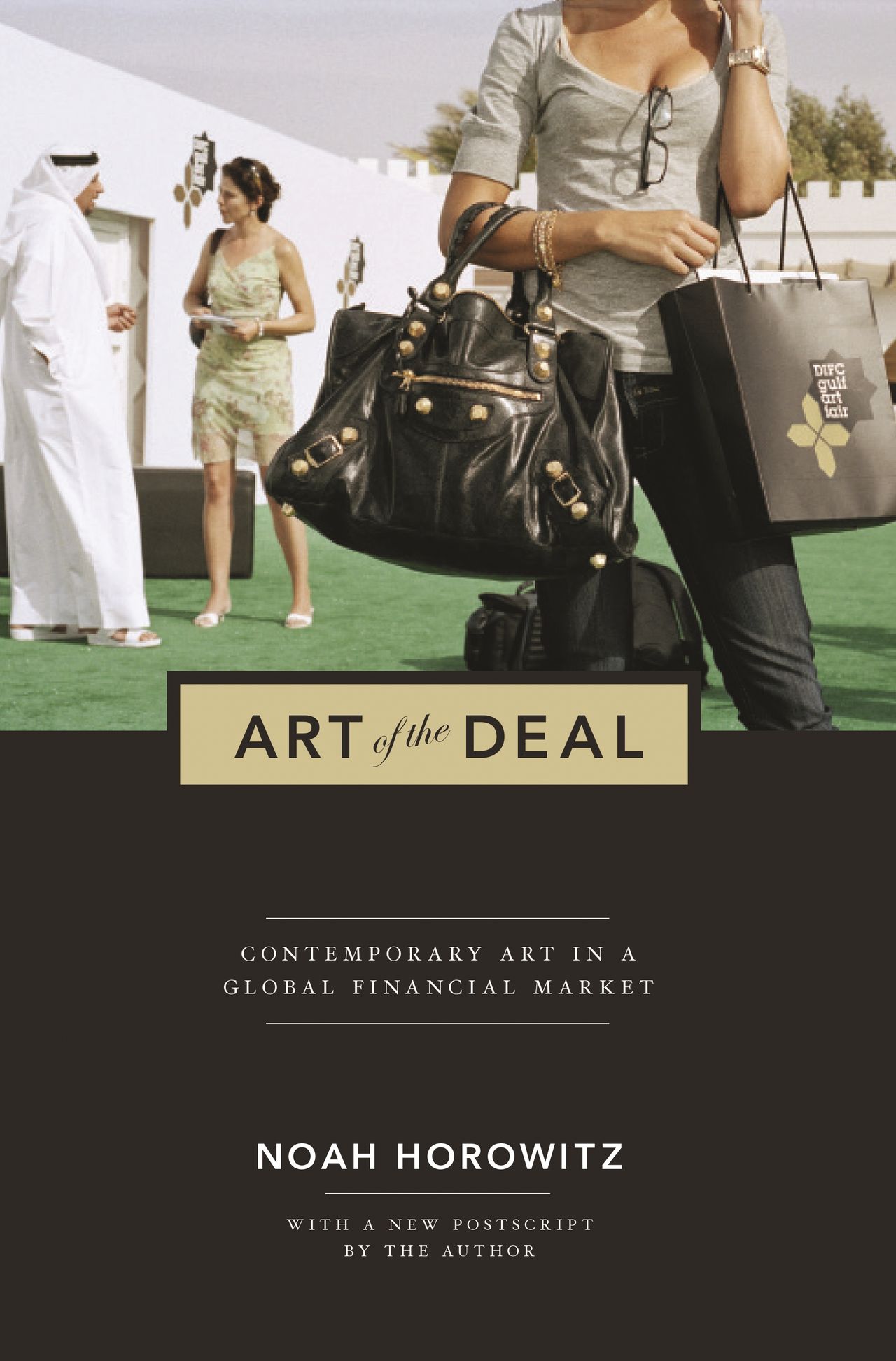
Cover of Art of the Deal: Contemporary Art in a Global Financial Market (2011). (Courtesy Princeton University Press)
SB: I feel like this book, which was your doctoral thesis from the Courtauld Institute, in London, or came out of it, has become this seminal text over fifteen years. Maybe you wouldn’t say that, but I think it’s okay for me to say that, and rereading it to prepare for this episode infinitely showed me why. There’s so many things that you write in that text that I feel like have only become more true with time, in a way. I’ll just quote from page 153 of the paperback edition here. You write, “Art’s intrinsic value makes it especially attractive during periods of high inflation as well as the notion that interest in art can rise during periods of financial and political turmoil: art as a reserve of unassailable meaning in difficult times.” So, it’s very relevant for this time that we’re in. I feel like art is basically something we cling to when there’s a lot of unknown being thrown at us.
NH: Yeah, and I think that that’s as true now as it was then. I think in the paperback edition—or maybe it was the original one; I did an afterword that was published after the fact—but the book was written and brought to print during the great financial crisis, and it opens with Damien Hirst’s sale and—
SB: The day Lehman Brothers collapsed, basically.
NH: Yeah, totally. And it’s not for nothing that that framing brings us up to the present, where you have [Maurizio] Cattelan’s golden toilet as the centerpiece of Sotheby’s entrée into the Met Breuer—or the Breuer, sorry, still says Met Breuer, by the way, on Uber, when you want to try to get there, still exists on Madison Avenue. [Laughter]
So, somehow that is a reflection or a reminder that—and I stand by this: The book itself charts art’s role as an asset or investment, which as a subject I exhausted and got a little bored of just looking at how paintings performed at auction. But if you go to the beginning of professionalized interest around art as an asset class, the beginning of that really is the rupture of the 1970s, and seventies stagflation, and the British Rail Pension Fund in the U.K. as part of the pensioners—at least for an allocation of their pension, they allocated to fine art, and created the first structured investment vehicle for riding out these waves—and it ultimately performed quite well.
That as a sort of throwback into where we are now is important, because in all of these cycles, like the seventies; again with the eighties boom-bust; and the rise of the impressionist market and Japanese speculation; and you then get to the nineties, which really is the bedrock of the moment that we inhabit now, so many of the names, the galleries, the artists that have come to define today’s moment all came of age then, and they all, many of them, were put on the map through the soft market of the nineties. The nineties was a pretty tough market environment. A lot of galleries went bust. The market, in a post–Berlin wall era, was becoming more global, but it was still New York, London. Berlin was just becoming a thing. And I firmly believe that through that moment, and this moment now, great art can get made, will get made in response to these moments of great change.
I mean, if you look at Rirkrit Tiravanija’s early “Pad Thai” performances…
SB: Which you write about so beautifully in the book.
NH: And Rirkrit’s, like—he’s everywhere. In Doha two weeks ago, with Qatar Museums, he was the celebrated artist du jour, doing the big evening performance at the I.M. Pei museum [Museum of Islamic Art]. So, that was my grounding. It’s just interesting how, especially at a moment where the commercial market is, it’s a little bit softer. And I’m not comparing 2025 to 1990—it’s very different. The market’s infinitely more global. There’s more wealth than there’s ever been, even if the market’s been sideways or down for two years, the baseline is so much higher than it was thirty-odd years ago.
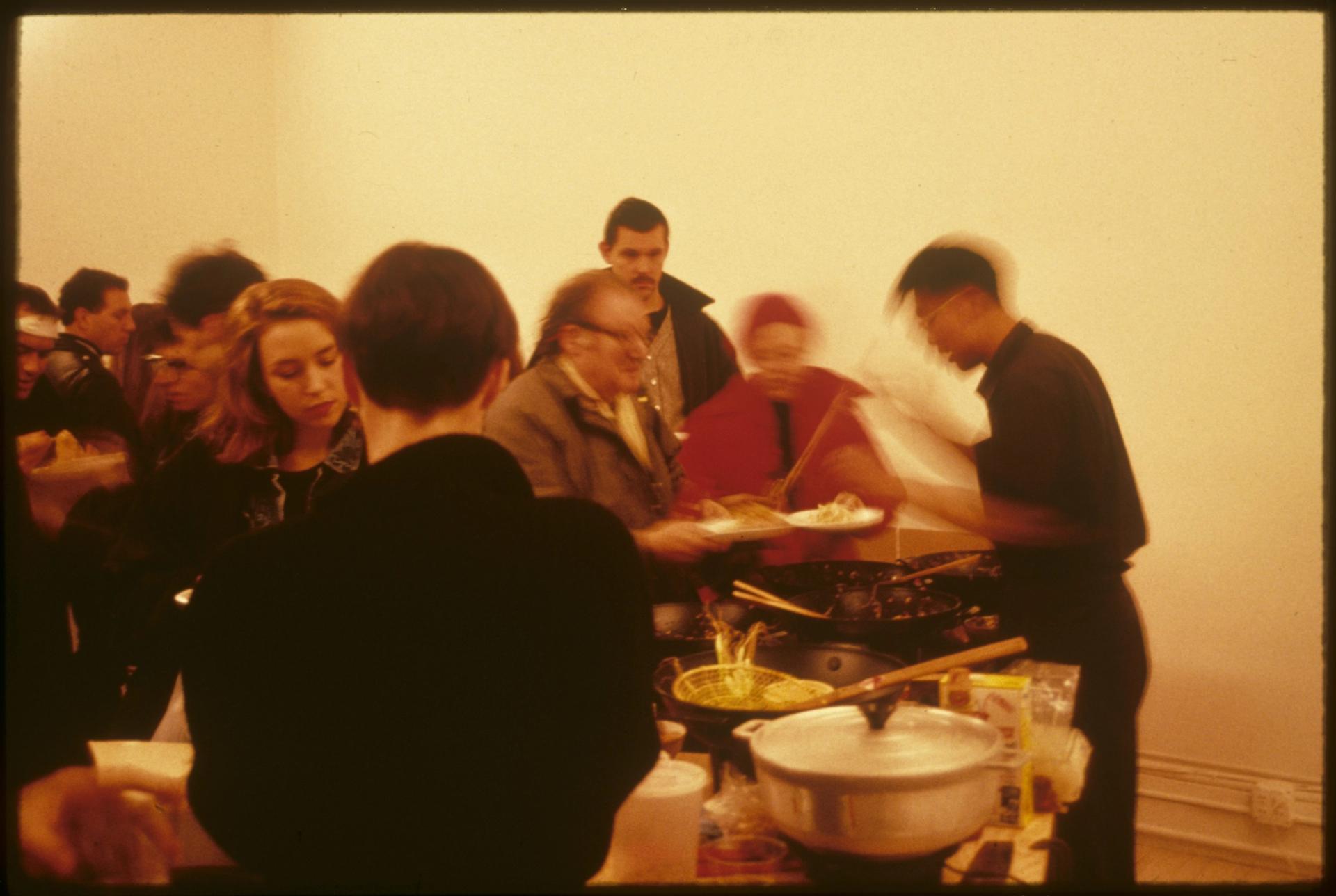
Rirkrit Tiravanija’s “untitled 1990 (pad thai),” the opening event in 1990 at Paula Allen Gallery in New York. (Courtesy the artist)
“As a moment of real creativity, I have extremely high hopes for the art that will be created in the next years, coming out of what can only be defined as a pretty wild geopolitical moment.”
But at the same time, conceptual experimentation, that jostling, that playing back… I mentioned Ray Naito’s, these balloons and this project is indexically pointing back to Félix González-Torres, who is undoubtedly one of my favorite artists and, I think, one of the great artists of our time. These moments of possibility are all there. And I think this hopefully is also one such moment where it’s imperative that the commercial structures are there and that more opportunities are created at a baseline commercial level. But, as a moment of real creativity, I have extremely high hopes for the art that will be created in the next years, coming out of what can only be defined as a pretty wild geopolitical moment.
SB: I think we get so stuck in thinking about the now that we forget this history you’re talking about from recent decades—or even centuries past. In your book you lay out this sort of great overtime arc of how we got to where the art market is today, or at least where it was a decade ago, I guess still where it’s today. I thought we’d maybe just bring that up, because it’s so interesting, you’re bringing this track back to the seventeenth century, the eighteenth century, where there was already a development of forms of patronage, primarily in the sort of royal sense of the term, but it evolved. Could you talk a little bit about that from your art-historical perspective, what you can recall?
NH: I can reflect on it a little bit. I think art has always been defined by money. Let’s be clear about that. Even going back into chapel or commissions and—
SB: Maybe even cave paintings, who knows?
[Laughter]
NH: It’s always about money, patronage, access to expensive materials and this color blue and so on and so forth. That all is real.
Interestingly, I got to Paris a few weeks ago via Amsterdam. I was there for a day and managed to pop into the Rijksmuseum. In the northern Renaissance, certainly in the Dutch context, there was a real civic bourgeois sort of leaning around art. It wasn’t just the ultra-wealthy. It was something that was lived in a more accessible way than just being papal commissions or state-run things by different kings and queens. I think that currency is really important: for art to be lived as a society, for people to feel that they have access.
I think bringing that up to now—I mean, there’s a lot of discussion in the market around resale royalties and artist agency, especially coming out of the latest market boom. But if you look at the beginnings of those conversations, even in the twentieth-century context, it all goes back to the early twentieth century, the time in the nineteen teens, when the first discussions of the Droit de suite and Artist Resale [Right] royalties, where a market started cascading for the first time in a commercial sense in terms of the trade in the early twentieth-century Parisian avant-garde. These things are, in my mind, fascinating, and I think if you look back in time, you can find a lot of indexical points to how our current environs are opening up.
The other thing I’d say on this is, as a student of history in terms of market cycles, one thing that’s always been the case is, as markets ebb and flow, there are pretty much two or three consistent themes: One, when one market bottoms out, the next is usually propelled forward by new audiences and new types of content. That’s always been the case. So, whether it was the rise of the American avant-garde coming out of postwar Europe in the midcentury… Or I was with a friend who was an auction executive last week talking about being at Christie’s in the early two thousands and mid–two thousands, when the idea of postwar and contemporary art was like blasphemy and all of a sudden, very quickly, sales of postwar and contemporary art eclipsed modern impressionist art—
SB: Yeah, the YBAs.
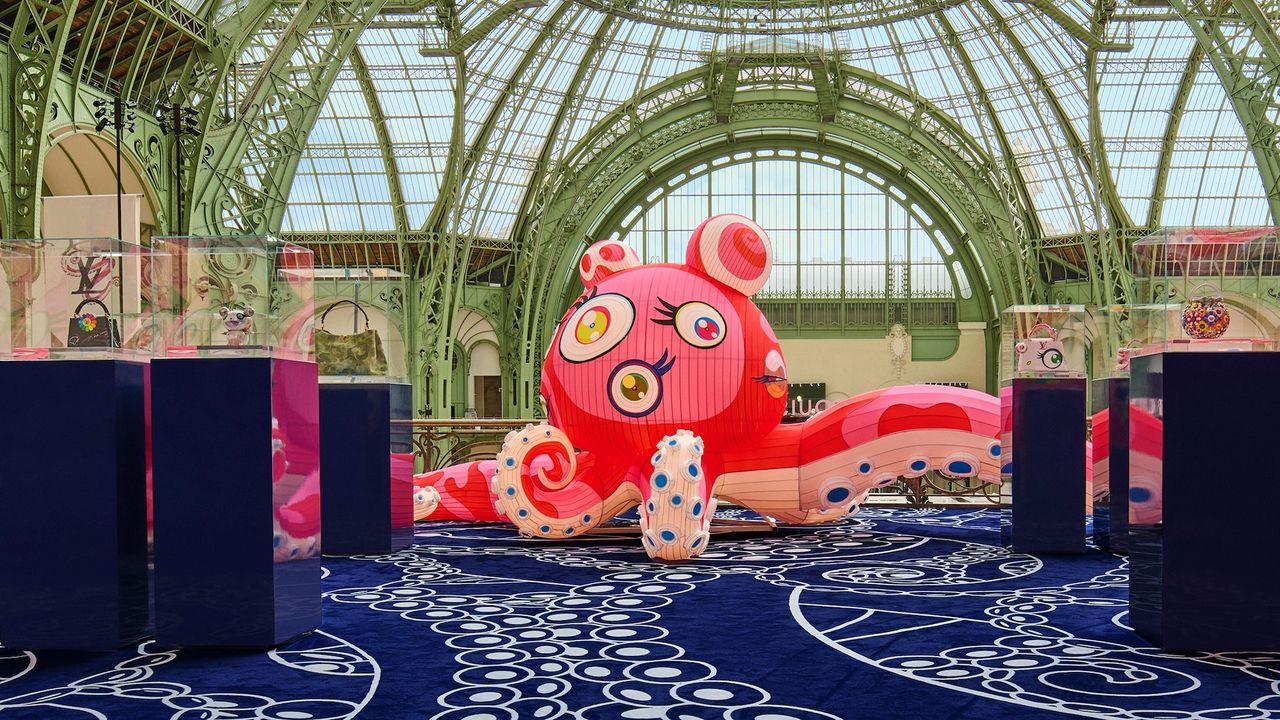
A view of the Takashi Murakami-designed octopus at the Balcon d’Honneur of the Grand Palais during Art Basel Paris 2025. (Copyright Takashi Murakami – Kaikai Kiki, Ltd. and Louis Vuitton Malletier.)
NH: Yeah. It didn’t seem possible. I think, now, we’re in this moment, as well where you have a global pull, but you’re bringing in different voices, whether that’s, like, KAWS, or whomever—[Takashi] Murakami, obviously the Dodgers just won the World Series and immediately it flips to Murakami’s new project with the L.A. Dodgers, or if you were in Paris with Louis Vuitton in the halls of the Grand Palais, this giant crazy octopus. So, there’s a lot that’s happening all at once, and what it has created is a more striated version of culture where all these things can exist somehow side by side, and we can all apply our own value lens to what we prefer.
SB: Just looking at the last twenty-five years, why do you think the art fair has so proliferated? What is it about this particular relatively short period of time?
NH: It delivered what the market was looking for. Again, as a student of history, the nineties were the “biennial decade.” Right after the [Berlin Wall] fell, there were biennials everywhere: Johannesburg Biennial, the Berlin Biennial, the Whitney Biennial—every city had to have a biennial.
SB: Yeah, it was like the “Bilbao effect,” but for the art world, right?
NH: Totally. Turns out, people want to buy things, and the art fair became, as the pace of business generally became more event-driven—also at auction, by the way; it’s not just an art fair, the private market side—art fairs delivered what the market was looking for. These extraordinary weeks on the calendar, where collectors but communities… It’s also a reminder, Spencer, that art is a lived thing. It’s buying and selling. It’s a marketplace, but it’s also a global community. And some of the great outcomes of fairs aren’t just the commercial outcomes, like how much something sold for or how much a gallery sold or whatnot. They’re the new leads that were generated, the new contacts and connections, and that’s really powerful.
SB: I have one of my best friendships in the world to thank Art Basel for, actually.
NH: Fantastic.
SB: I met this person at Art Basel Miami Beach, and they are one of my closest friends.
“This is lived culture. This isn’t a petri dish; this isn’t a scientific experiment. People come to these platforms because they genuinely want to be there.”
NH: Yeah, well, we were at a wedding with some friends that will remain unnamed in New York in September, and they met in Basel. All the wedding speeches, it was like Basel propaganda. It was extraordinary. But it’s a beautiful reminder of the power of culture. This is lived culture. This isn’t a petri dish; this isn’t a scientific experiment. People come to these platforms because they genuinely want to be there. We do not, as a business, pay celebrities to endorse Art Basel. That’s just not what we do.
SB: Yeah.
NH: We create the possibility for extraordinary things to happen. And it just so happens that people of a certain influence or cultural intrigue genuinely want to be there of their own accord, and that’s the most powerful endorsement of the brand and of a platform that you can get.
SB: Yeah, It’s the sort of heart, the core, the center of—if we’re just talking, in the case of Miami, at least, the core of what happens there, there’s a lot of ancillary things that happen around the fair that have nothing to do with the fair.
“In the end, we’re all stretched for time. New York is the greatest cultural capital in the world, but to properly see what’s going on in the New York cultural landscape, or just the fine-art landscape, you’ve gotta dedicate days of time.”
NH: They all create something that’s more, and I think in the end, we’re all stretched for time, we’re stretched for resources. New York is the greatest cultural capital in the world, but to properly see what’s going on in the New York cultural landscape, or just the fine-art landscape, you’ve gotta dedicate days of time. Then every four to six weeks, as the exhibitions turn over, recalibrate that. And that takes time, it takes focus. It takes time on your weekends or your evenings to go to those things. An art fair delivers that in bite size.
SB: Hyper-speed, also, right?
NH: Hyper-speed. In a very, very consolidated way. One of my really good friends who bought a new apartment recently reached out and said, “Hey, I’ve got this much to spend, what should I do?” I gave him a checklist of fifteen galleries to see in New York. Then I kid myself. I just said, “Actually, what are you doing in December? You just come to Miami for two days for Basel, because actually it’s way more efficient for you and your time. And you’ll see in the Miami Beach Convention Center, you’ll see two hundred and fifty, three hundred galleries. You’ll meet people in the real, you’ll meet artists.” It’s actually just as a consumer, it’s a more efficient way of going about one’s business.
SB: I mean, this is what I was talking about with time. It’s like that scene in Star Wars [in The Empire Strikes Back] where the screen kind of just goes into hyper-speed, right? That’s sort of what it feels like to go to Art Basel for a few days.
NH: Yeah, it can. And again, our great hope, just to be very clear on this matter: Our gallery clients need to build sustainable businesses that work without Art Basel. Let’s be very clear. That’s super important. But Art Basel as a fair as a platform should help accelerate, further perpetuate, and grow that base. Increasingly, in a world where buying and selling is more modulated and it’s more event-focused, we recognize that these moments as calls to action become that much more important. It’s very hard to sell things in the private market. Auctions work because there’s a hundred things that are going to be sold. You have a sense of what the pricing is based on the estimates that are set. And if you don’t bid now, it’s gone, and the private market needs that. Art Basel as a platform has created this extraordinarily well-oiled recall to generate that on behalf of the global market. We do it now with more audiences and more constituents the world over.
SB: Let’s get personal. I wanted to go into your background here, growing up in Princeton, New Jersey. I know you were interested in art at a young age, primarily through film and music. Is that right? Tell me, what are some of your earliest art memories?
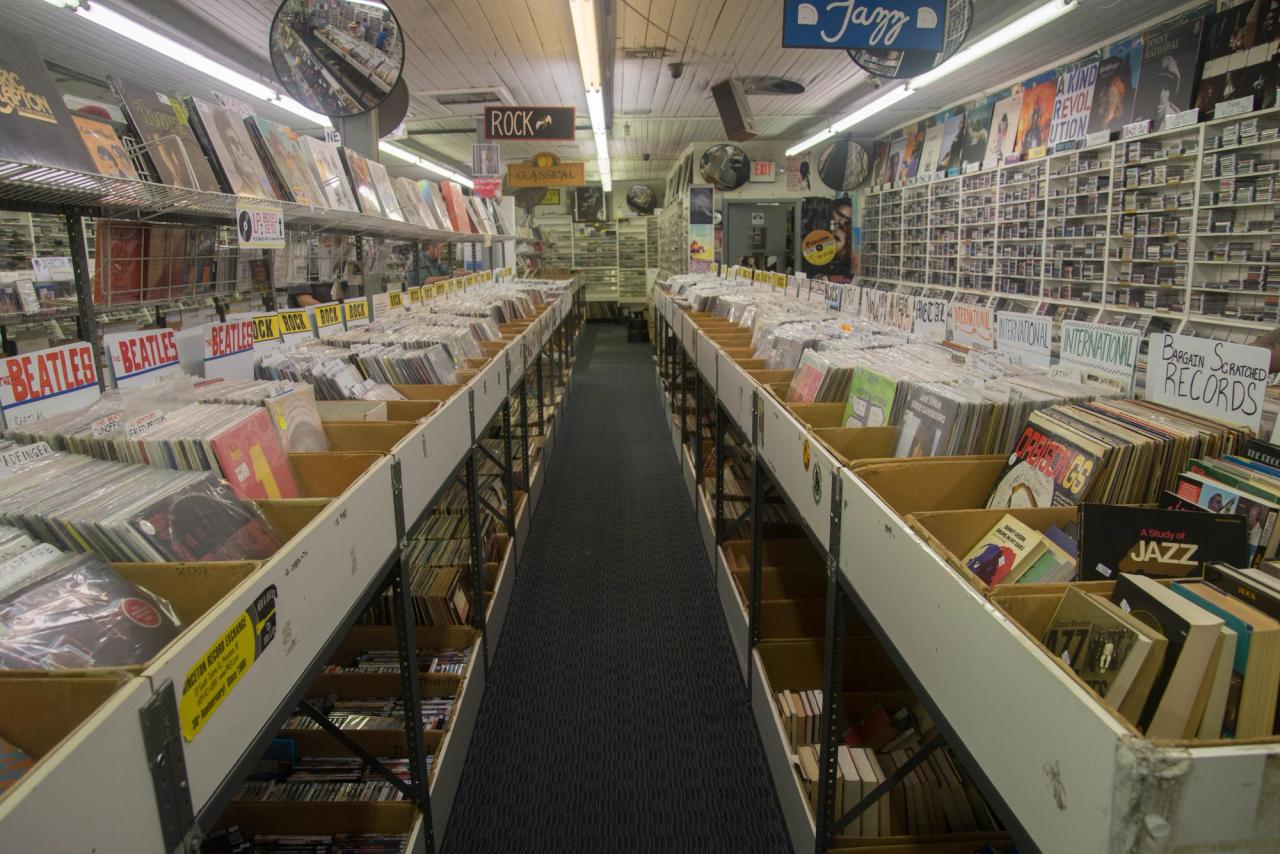
Inside Princeton Record Exchange in downtown Princeton, New Jersey. (Photo: Jeff Rusnak/Courtesy Jon Lambert)
NH: Yeah, I grew up in an upper middle-class household. My dad was a doctor. We had a loving family, but we had no toe in the art world to speak of at all. But as a suburban kid in the eighties and nineties, we had music, we had film. I was a huge Tarantino junkie. I grew up in Princeton, which is not the most culturally forward of towns, but it did have the Princeton Record Exchange. It still does.
SB: And there’s the Princeton University Art Museum.
NH: Which has just gotten rebooted. But I’ll be honest, I didn’t have creative—
SB: 2.0.
NH: … experiences.
SB: 2.0 now. [Laughs]
NH: I still need to go. I mean, that is quite a new contribution to civic culture in Princeton.
But the Record Exchange is the place. If you ever want to go in any place in the world and feel like a tiny pea, go into the Record Exchange and talk to the guy behind the desk about what’s cool in the music world, and that guy will put you in your place really, really quickly. And that was my reference. I would listen to Ween or Phish. I remember De La Soul’s 3 Feet High and Rising. It was the first album I memorized end to end. Maybe through some of that, I have very distinct memories going to the Philadelphia Museum of Art as a kid on school trips or with my family seeing the Brâncuşis and the Duchamps just kind of querying what that was. I remember going to the Institute for Advanced Study and finding the rhombus like Tony Smith’s [“New Piece” (1966)] rhombus, this sculpture in the woods, and it was a reference point in music culture, but it was like a thing and you’d go climb on it. It was like, wow.
But I never ever thought that I would develop a career doing this stuff. But then life happens. I went to the University of Virginia. I was just down in Charlottesville actually this past weekend. I just joined the board of the Fralin, the art museum there, quite cool. I got into the honors program at UVA. I was an econ major, I declared that quickly. But I took a lot of classes in art, foreign affairs, finance, and I just had this interest in alternative investing, the value of culture. I was a summer analyst my last summer at Goldman Sachs in the media and research team. I figured that was a thing to do. That’s what many students of my generation were pursuing as a career. I was a summer analyst the summer of 2001. 9/11 happened, and lo and behold, I didn’t have a job offer and had to rethink, pivot.
I had two great advisors at UVA. One was Howard Singerman, who’s a really important arts educator. Another was a professor in the commerce school. They had a great business school in an undergrad commerce school at UVA. They said, “Hey, have you ever heard of this place called the Courtauld in London?” There’s a great political economist there, a guy called Julian Stallabrass who had just written High Art Lite and was gaining some notoriety. High Art Lite was like the great takedown of the YBAs. I’d never heard of the Courtauld, never heard of Julian. But I applied and ended up getting a scholarship. I moved to London. One year of doing a master’s degree turned into this like, Huh, I wonder what the deal is with investing in art. And I spent the next—
SB: This is right as Art Basel Miami Beach was starting to—
NH: Yeah. This would’ve been the beginning. I was in London, starting in the fall of 2002. Miami was supposed to be December of ’01. It was delayed due to some combination of 9/11 and anthrax, actually. So, it was pushed back a year.
As I said, I didn’t go to the first Miami, but I did go to the first Frieze, which, the Frieze started in Regents Park the fall of ’03. And I spent the next year exhausting any bit of literature on—
SB: Art and money.
NH: Art and money. The econometrics of art. I just started meeting people. I didn’t know anything. I just followed my instinct, which was to get into the field and talk to people. And as I started calibrating, I started meeting artists and curators and some gallerists.
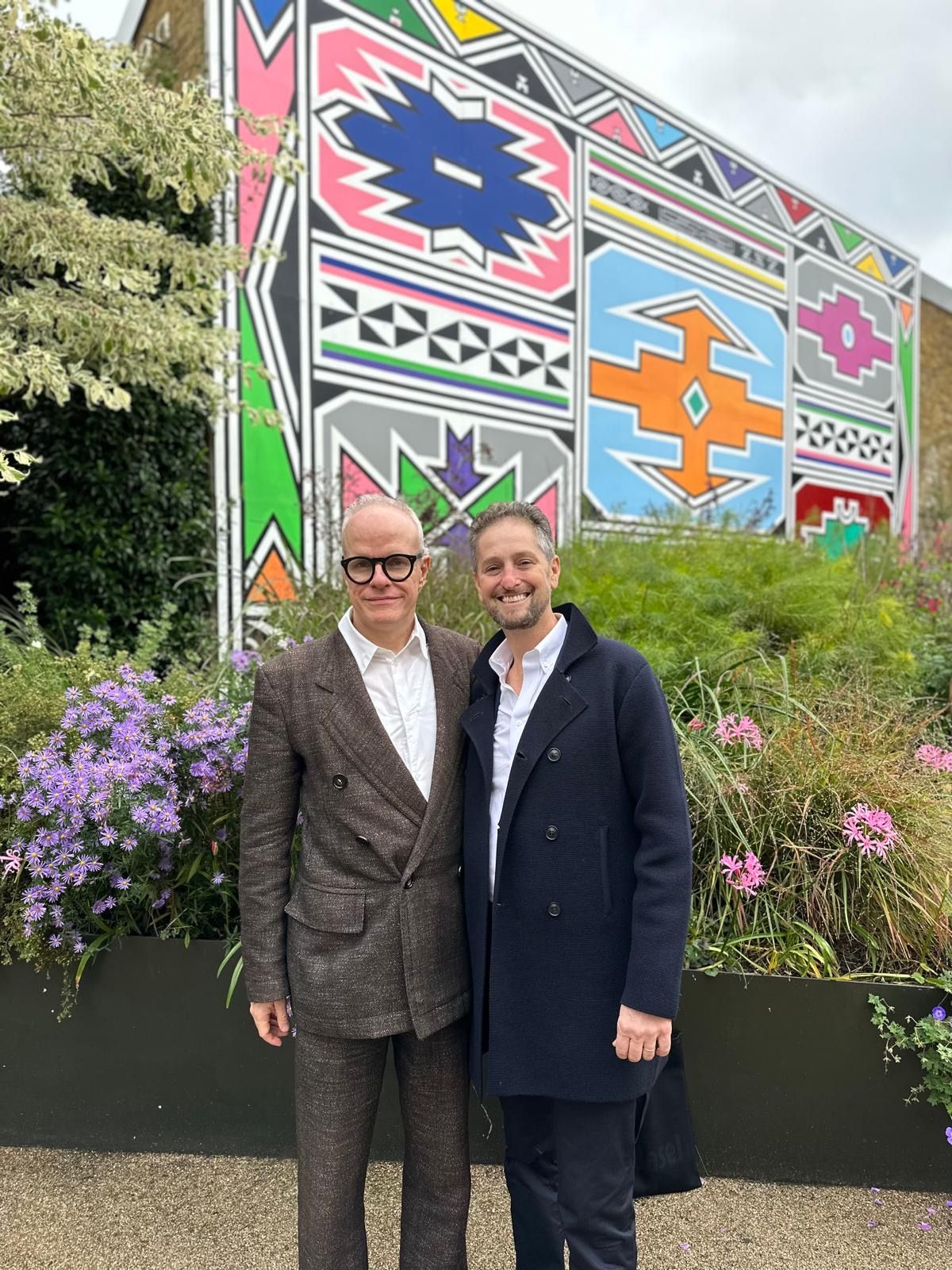
Hans Ulrich Obrist, left, with Horowitz. (Courtesy Noah Horowitz)
SB: You worked for the Serpentine Gallery, right?
NH: Well, I met Hans Ulrich Obrist via Liam Gillick, actually, who I had interviewed. And Liam invited me to Munich to come to the “Utopia Station,” which was this thing that started at the Venice Biennial, and they did the second iteration at the Haus Der Kunst when Chris Dercon was there. I remember meeting Okwui Enwezor and Hans Ulrich and we’re speaking in an interview, and—this is one of my great stories, the story to end all stories was I had this 6:30 meeting with Hans Ulrich, and that’s when he—
SB: In the morning.
NH: In the morning, of course.
SB: Yeah, a “Brutally Early Morning.”
NH: Yeah, there were “Brutally Early” mornings and there were “Hyper-Earlies.” I actually don’t remember which, whether Brutally Early Club or Hyper Early Club was earlier than the other, but they were hellishly early. And the time I was given was 6:30. And we met at this café and I took out this recording technology on my laptop to record my interview with Hans. He was so sort of envious and jealous of this recording technology that we just talked about the recording technology for the hour allocated and we never got to do the interview.
SB: [Laughs]
NH: So then he invited me back the next day and I recorded my interview with him, and what ended up happening was this beautiful thing. He was at the Musée d’Art Moderne [de la Ville de Paris] and he started giving me transcriptions and stuff that today you just throw at an A.I. bot. But that’s how I started. I started transcribing Hans’s interviews with all these extraordinary people he speaks to. When he moved to London to take the Serpentine gig, he reached out, and I was like a summer exhibition assistant on this American group show [“Uncertain States of America”]. And that was the beginning.
SB: I mean, there’s really, you describe it [in Art of the Deal] as a “hurricane world of friends, ideas, and energy for art.” And it is. There’s this palpable whirlwind around Hans Ulrich, and I can imagine that must have been so informative for your work. It’s like an entrée into this medley that is the art world.
NH: Yeah, I mean, look, Hans Ulrich is… He talks about “hurricanes,” but he really, when you’re with him, you feel very important. He has this extraordinary ability to make the people around him feel like they’re the center of the world.
SB: And everything’s urgent.
NH: Everything is super urgent. One of the funniest voicemails I’ve ever received, and it’s a shame that it fell off my phone, was during the first of the Serpentine Marathons when Hans and Rem Koolhaas stayed up all night to—this was probably summer of 2006 or ’07, when Rem had his Serpentine Pavilion. They did this twenty-four-hour conversation marathon, and I worked late into the night and then went home. I was a staff member and everybody got divided into four- or six-hour shifts. And at 3:00 in the morning I received this frantic voicemail from Hans’s assistant saying that there was a fruit emergency and that Hans and Rem needed a very specific type of fruit in the middle of the night, and it was absolutely priceless.
SB: [Laughts]
NH: But yes, it was a frenzied scene. I think before getting to Hans, though in terms of going back to the beginning, it kind of goes back to Princeton in a funny way.
It was that moment between finishing at Virginia and moving to London that really cemented my chosen path. It was the summer of 2002, and I was leaving university. I decided I was going to stay at home for the summer, and I didn’t know what I was going to do. I reached out to Kirk Varnedoe, who was the chief curator of painting and sculpture for many years at The Modern, and had taken a post—he had cancer, so it was a very sad, emotional moment for him. He’d taken a post at the Institute for Advanced Study in Princeton, and I reached out to him cold and I just said, “Hey, I live in the area. I’m going to the Courtauld, and it’d be nice to meet.” He invited me for lunch and ended up giving me a job working as a research assistant. He was preparing the Mellon Lectures at the National Gallery in D.C.
SB: I found this out about you in researching for this. And I watched a few of those lectures.
NH: Oh, wow.
SB: I have to say, there are four of them [Editor’s note: There are actually six, which can be viewed here], and they’re like a master class in abstract art. It’s really… To all the listeners interested in abstract art, go watch these.
NH: They became a book called Pictures of Nothing. Kirk was one of the more inspiring people I ever met. One of the great orators and lecturers on art and the potential of art, why artists and art is just important. He gave me the confidence, or the kind of line of sight, to somehow see that this was a thing that you could build a career around and that this was what I was going to do. Up until then, I had no idea.
Then meeting Hans Urich and entering his universe a number of years later accelerated that. But I think Kirk really, if there’s one person that you could point to that gave me the internal confidence to know I could do this, it really came through that summer and the next year working together. Then, man, he delivered his lectures and very shortly thereafter passed away. It was a real touching chapter in my life.
SB: The research on those lectures, the transcribing of Hans Ulrich’s interviews—that right there is an education unto itself.
NH: Yeah, I didn’t know anything, right? He would just be like, “Go find this article,” and I’d go spend two days in a stack somewhere and try to find it, and then I’d read a little bit. I have no idea what it was about. Somewhere at home, I think I still have all the dossiers that I prepared for him.
SB: I think it’s also worth mentioning that when you started working on what became Art of the Deal—and there still is to some extent, but there was much more opaqueness around art and money. I feel like your book does this really powerful thing, which is to show this link not just in historical terms, but also through an art-world lens. It’s not just an economics [thing], as you were saying earlier. It’s not like this is just, “These are the auction sales, this is the economics of it.” There’s a whole culture and a social aspect to value here.
NH: Totally. I was speaking just last week actually to a financially literate audience about the state of the market, and somebody came up to me after and said, “Hey, I used the appendix of your book to map out…” Somebody was starting an art investment fund of some sort, and they didn’t know the history of these funds and where this stuff really came from.
SB: Jeffrey Deitch co-founding a Citibank art advisory.
NH: Extraordinary, right? And that’s how Jeffrey began. There’s a whole network and world of people around Jeffrey, including our colleague Stefanie [Block] Reed in Miami, who has been with Art Basel since the late nineties. If I recall correctly, she met her husband, or then husband, Evan [Jared Reed] through Jeffrey’s world.
“It is absolutely timeless that art is a financial instrument; it’s an ‘asset,’ if you want to call it that. But in the end, it’s a social good.”
So, again, there are material and concrete things, but there’s a lived world of culture that we’re all a part of. Some of that is art investment–specific, but a lot of that is day to day. It’s not for nothing. Olav Velthuis, his Talking Prices was really the kind of bedrock of… He was a Ph.D. sociologist, if I recall correctly, but his book, which inspired a lot of my writing, was really about the signals and coding of value creation in the art market. One of the things that Olav talks about is just the familial nature of artists, gallery, collector relationships, and you just continue to see that lived out. And it is absolutely timeless that it’s a financial instrument; it’s an “asset,” if you want to call it that. But in the end, it’s a social good.
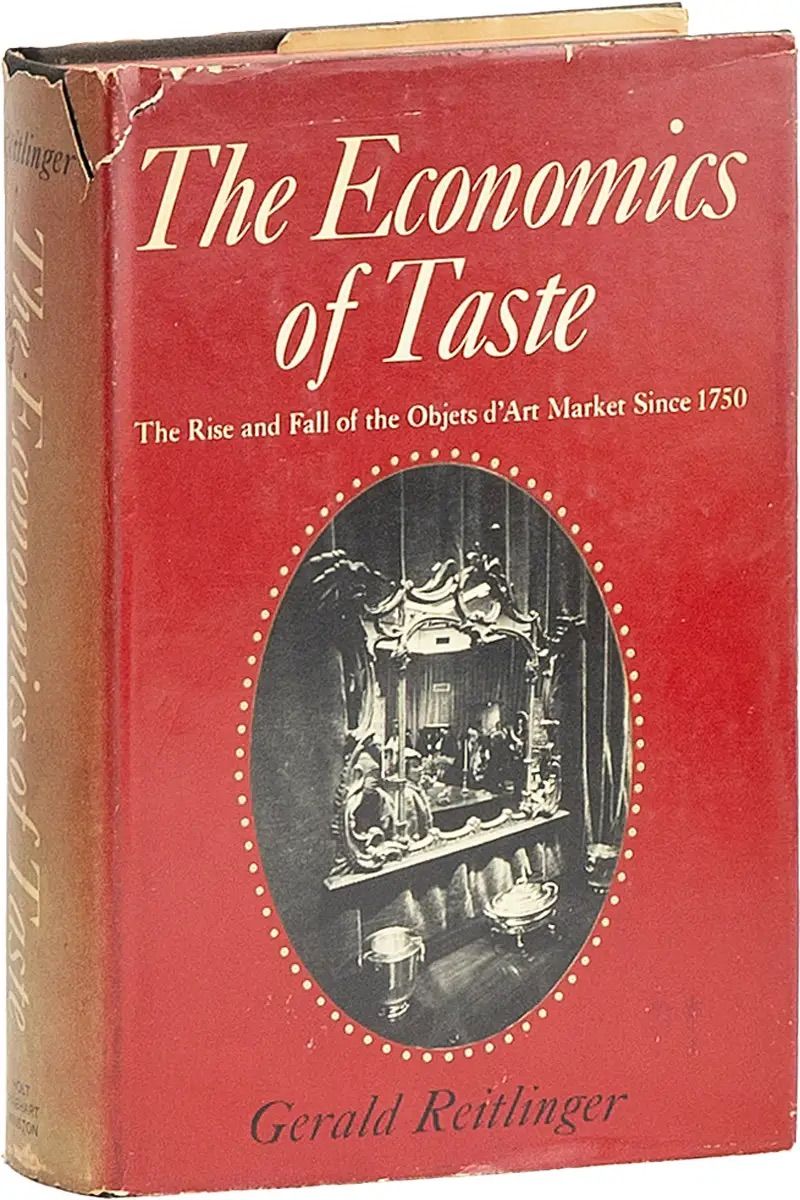
Cover of The Economics of Taste by Gerald Reitlinger (1965). (Courtesy Holt, Rinehart and Winston)
SB: It’s probably one of the most beautiful, enjoyable financial instruments, too, if you frame it that way. [Laughs]
Just thinking about the literature that’s been written on this, you also quote and reference in your book Richard Rush’s Art as an Investment, from 1961; Gerald Reitlinger’s The Economics of Taste, which was published in three volumes between 1961 and 1970. There were predecessors that led to your book. I’m not saying your book was the first, but certainly, it’s interesting that this literature now I think has become more understood in the world of art.
NH: Yeah, I think that that’s important. Again, we’re all paddling in the same direction. So, Reitlinger was the famous— I think he was an economic historian, but basically he’s the one that gathered all the pricing archives from the seventeenth century forward. Or John Michael Montias, [who was] a professor and did all that sort of heavy lifting work on the Dutch North, the northern Renaissance in Amsterdam, and you have all these other guys.
Now, fast-forwarding to present, we do our part—and it’s something that I’m very involved with and really believe in with Clare McAndrew and UBS—the Global Art Market Report and the surveys of global collecting. But there’s a lot of other analytics out there now, and I think that that’s great. I think one of the impediments to the art market, if I say so, so directly, are just these artificial boundaries. When we look at the world and how people are consuming culture today, I think that transparency is really important. As we press outward beyond… We’re in a moment of extraordinary shifts in collecting and patronage generally, where some of the old guard that really put the market on the map are aging out; some of them are passing away; their children aren’t necessarily collecting with the same fervor. But more than making up for that is a younger, more global world of collectors that is very female-driven, and many are coming to our world through different spheres of influence and through gaining their wealth in different ways. They’re trying to query what they’re buying, what they’re looking at. I think our community has not done the work that it needs to do and needs to do more of, in terms of welcoming in new prospective buyers, collectors, future patrons, and so on and so forth.
At Art Basel, we’re getting more and more precise about how we talk about this. It went from talking just about collectors and patrons to art lovers and buyers and audiences that may come and not necessarily collect, but they may spend money and buy. That liquidity is really important. I think, more and more, galleries lever our platform again to create this sort of fleeting moment of needing to take action for their most important clients, but then casting a very, very wide net across other would-be new collectors, new buyers that they can create touchpoints with. All of that is what makes that possible and important.
SB: Well, there’s also, to use an overused term, the “experience economy.” I think millennials and Gen Z are seeking experiences as much or even more so than previous generations. It feels to me like the next generations value experiences more than stuff.
NH: I think that this is overwrought to a degree. I’ve been talking about experience economy since I was—
SB: Yeah, it’s in your book. There was a book you reference by Joseph Pine and John Gilmore, called The Experience Economy.
NH: Yeah, that was a really important book at the time. I haven’t heard of it since then. I’m sure it’s still important, but I’ll say this: It’s been a challenging moment in the art market cycle. Art Basel, which performed really well in June… It was also a wake-up call just after, when Tim Blum closed his gallery [Blum] and then [Adam Lindemann’s] Venus Over Manhattan shut and Olivier [Babin] from Clearing also would announce his closure. Some people that are very close to the Art Basel family closed it down.
I spent a lot of time this summer with Vincenzo de Bellis, our chief artistic officer and global director of the fairs, and our other fair directors really canvassing in a very, very deep and measured way our clients. I sat down with one of our most important gallery clients, and he said something to me that was a real eye-opener. He said, “No, Noah, nobody comes to Art Basel anymore to be the first to buy something. They come because it fits their lifestyle.” That was a real eye-opener. This is a gallery that does our fairs globally, leverages the platform arguably better than anybody else, or at least as good as anybody else. Even for him, in his role, to really put his finger on it is a real wake-up call.
“What’s definitely not a thing of the past is the fact that a lifestyle around art and luxury and where you eat and where you sleep and where else you shop and what else you do outside of the hours that you’re in an art fair is really important.”
Of course, there’s a conceit there. Collectors very much come to be the first to buy something, but the moment of a collector putting on a fake mustache and finding how to hack an exhibitor badge and sneak in an hour before the preview maybe is a bit of a thing of the past. But what’s definitely not a thing of the past is the fact that a lifestyle around art and luxury and where you eat and where you sleep and where else you shop and what else you do outside of the hours that you’re in an art fair is really important. That’s really important for Art Basel, but it’s important for our industry as a whole. Even for me running the Art Basel business, here I’ve really learned a lot as a manager and as a CEO. I’m intensely proud of what we do and believe that we are best in class. In the halls of the fair, if you go gallery to gallery, we are as good as it gets. What visitors would’ve seen in Paris and what they’re going to see in a few weeks in Miami is absolutely emblematic of that—some of the greatest art in the world, across all spectrums, and it’s awesome.
But there are things we can do better. We have to be better on our hospitality, on our V.I.P. servicing. We have to be better outside of the halls of the show. And if we start comping to other major global events and luxury offerings, the things that our clients have come to expect, the bar has risen and risen and risen and risen. I think that there is some significant room for improvement, even for Art Basel at the very top end of that. As a business, we’re open about that and we’re calibrating in real time and we’re starting off a pretty extraordinary base. But we’re cognizant that—as a business that’s looking to grow and evolve and continue to be best in class, not just for this moment but for the next fifty years—putting the right fundamentals in place, bringing in insights, listening to people out of industry, really having our ear to the ground on a global basis, but through a much more striated customer base, is really important.
I, as a CEO, spend less time in the back rooms of galleries talking about artistic programs. We have an awesome team under Vincenzo that does that—and I do a lot of that still, too—but looking at what we can do on our digital side, what we do with marketing, what we can do with our content, the stories we can tell to engage audiences. We’ve started doing more with the Art Basel shop and creating different touchpoints through those means. We’ve started this new digital initiative called Zero 10, which I think is interesting.
SB: That’s going to launch at Miami, right?
NH: It’s going to launch in Miami, yeah. It’s a lean-in to the unknown at some level. And it gets back to this fundamental thing. And speaking of market cycles, it would be inarguable to me as the CEO of this business to not acknowledge that technology is going to play a huge role in shaping cultural production in the next years. There are, as a result of that, artists and cultural practitioners using that technology to make things and using those technological means to create different distribution mechanisms in different ways of creating touchpoints with communities. Also—and it’s a conceptual art conceit—like the role of the audience. Like Lawrence Weiner: an artwork may or may not exist, and it’s up to the receiver to figure out whether you bring it into being. It’s much the same with a lot of this production you see co-created.
SB: Rirkrit’s work too.
NH: Rirkrit’s work, all of this work. It’s either… It’s an idea, but it only becomes art when certain engagements and certain ownership and agency is taken on board. As we look at that through the lens of what’s happening in this digital world, like the boom-bust of the NFT frenzy has happened, and I think that’s in our rearview mirror, but something’s definitely bubbling up there. From an Art Basel leadership standpoint, we feel it’s important to lean in, and to figure out how to build bridges, because fundamentally, Spencer, I have a fiduciary to deliver new audiences to our gallery clients and to the artists that are within the Art Basel umbrella, but also to further advance the kinds of art that are sitting in that realm—and opportunities within that realm.
There are a lot of artists that show in our galleries or show in museums that are experimenting with technology. [They] probably have hit certain barriers or walls in terms of how to fund these projects or how to gain access to this or that. Our other hope with Zero 10 is that it creates a more fluid exchange between our existing artists and gallery audiences and new ones. It’s a bit of a lean-in to the unknown, but it’s something that I think it feels right and it’s something that we’re excited about and will be fully behind in Miami and then heading into next year.
SB: Well, it’s exciting to see how Art Basel evolves—or matures, I think is probably even a better word. I went back to this 2010 piece that Guy Trebay wrote in The New York Times about Art Basel Miami Beach, and in it he asks, “What is Art Basel Miami Beach precisely? Is it merely an art-world trade fair, one of scores now scheduled in succession across the planet? Is it, like much else in Miami Beach, just another over-hyped cross-platform marketing opportunity? Is it a pre-Christmas break for global billionaires?” And it’s funny, because it’s like, at the time, those questions all felt very real, but now that it’s twenty-three years old, it feels a little different. It feels like there’s some sort of maturation is the word. I’ve been going to the fair probably at least for twelve years or so, and in that time, I’ve seen it just go from being this very hyped-up festival to something that now seems—it’s still Miami, but it seems like we’re entering a new phase. Would you agree?
NH: Yeah, a hundred percent. I think we’ve been in that new phase for some time now. So, I think, to Guy Trebay, it’s all of those things, but it’s also very real. I think one of the interesting outcomes in Miami culturally is that, first of all, there are, finally, in the last years, a number of really progressive and interesting galleries locally that just weren’t there in the beginning. In the beginning there was Fred Snitzer, who was on the original committee; David Castillo came into the frame; and now with Nina Johnson, Anthony Spinello, and a number of others—Central Fine—there’s a great local ecosystem of interesting galleries. But Miami, through the private collections, through Norman and Irma Braman’s patronage and the ICA Miami, through Don and Mera [Rubell] and the Rubell [Museum] collection, through Marty Margulies, through the De La Cruzes, through Craig Robins and all he’s done in the Design District.
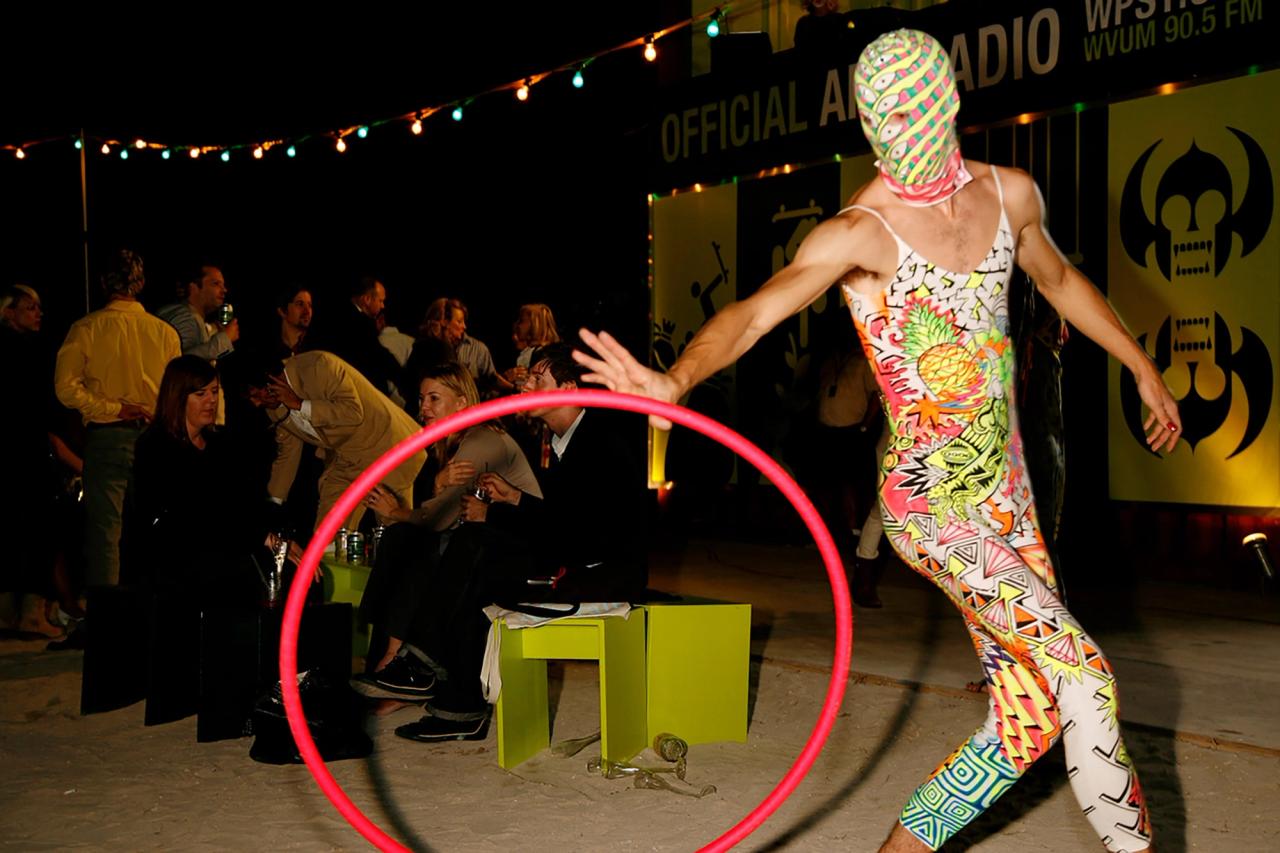
A performance during the opening night of Art Positions at Art Basel Miami Beach 2007. (Courtesy Art Basel)
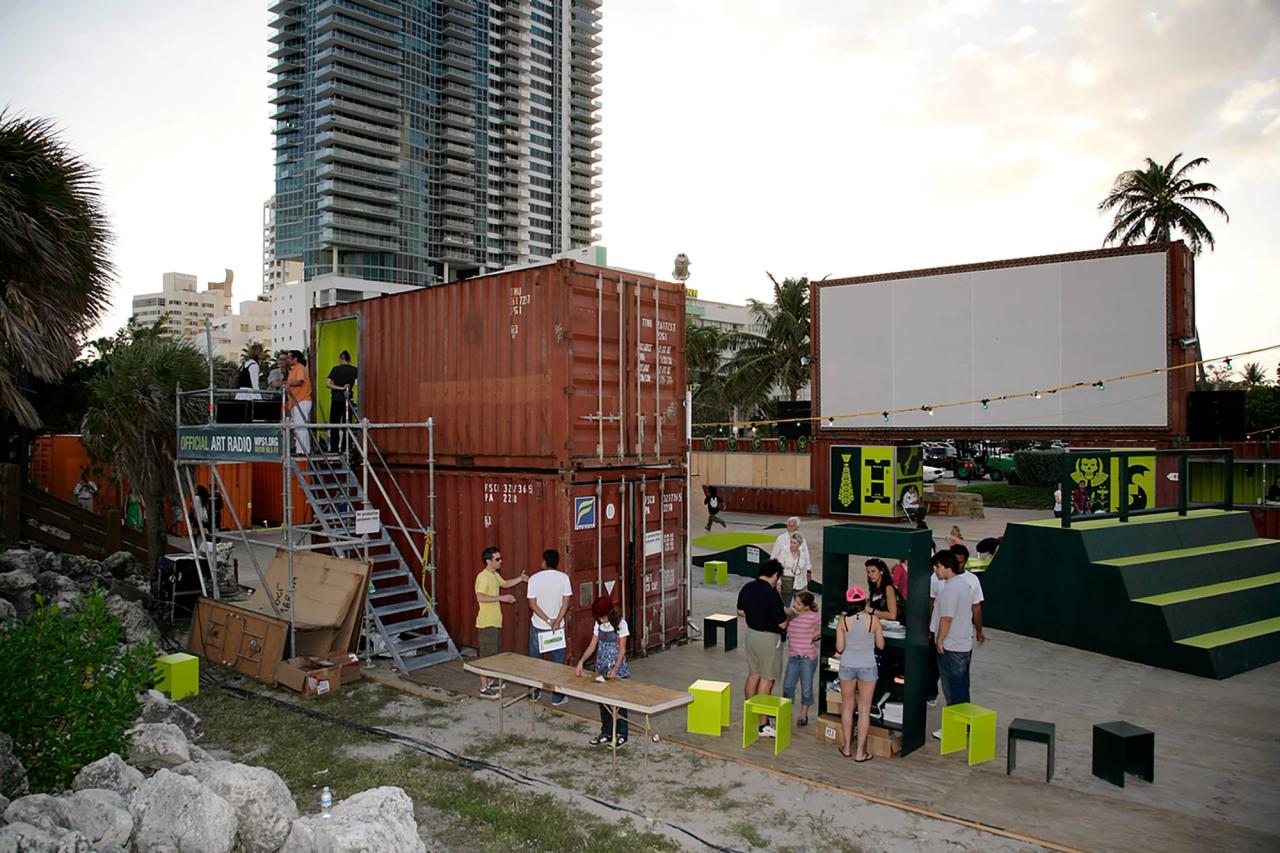
Off-site programming during an early edition of Art Basel Miami Beach. (Courtesy Art Basel)
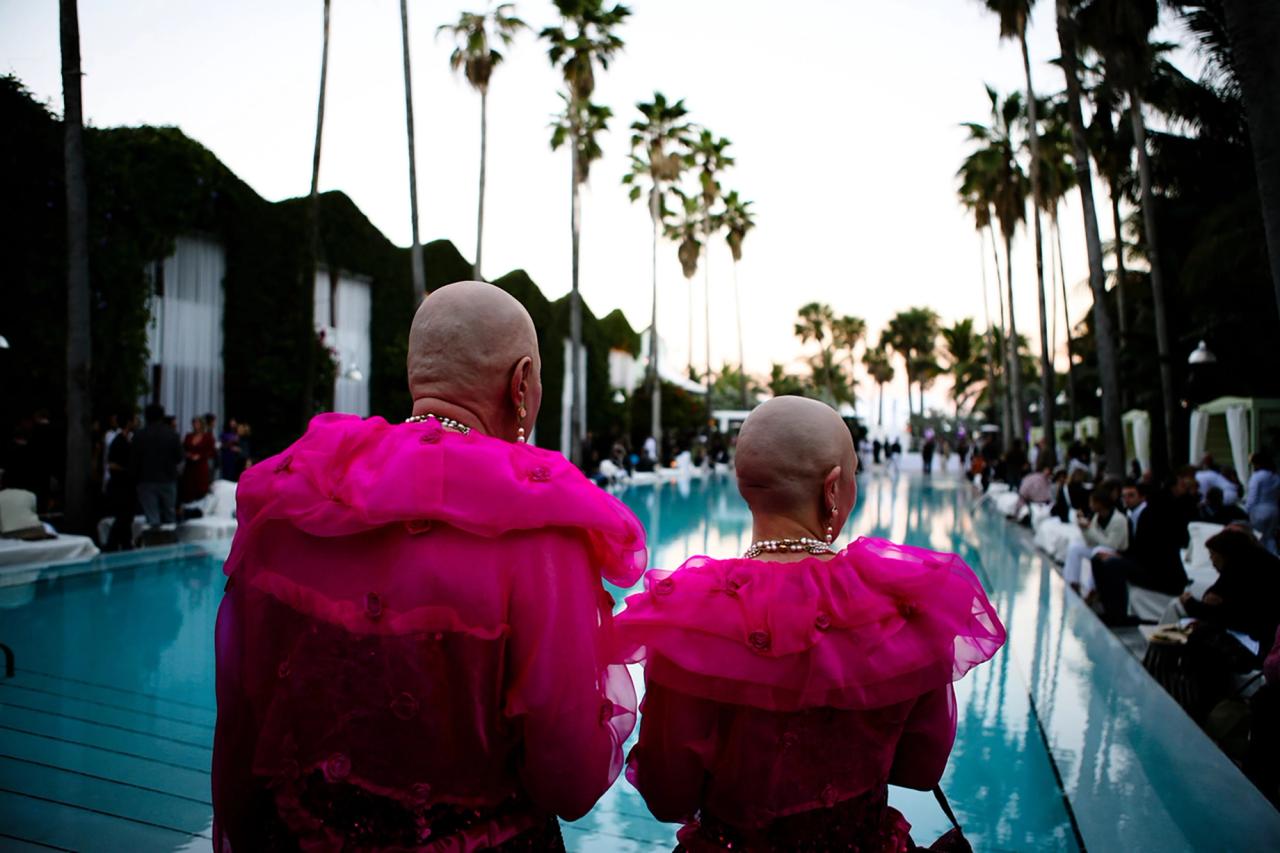
Guests at an Art Basel Miami Beach welcome reception. (Courtesy Art Basel)

Clockwise from top: An Art Basel Miami Beach VIP card; The 2002 Ocean Drive cover debuts ABMB; The inaugural 2002 one-day ABMB ticket. (Ticket and magazine cover photos courtesy Art Basel/Vasari Project)
A performance during the opening night of Art Positions at Art Basel Miami Beach 2007. (Courtesy Art Basel)
Off-site programming during an early edition of Art Basel Miami Beach. (Courtesy Art Basel)
Guests at an Art Basel Miami Beach welcome reception. (Courtesy Art Basel)
Clockwise from top: An Art Basel Miami Beach VIP card; The 2002 Ocean Drive cover debuts ABMB; The inaugural 2002 one-day ABMB ticket. (Ticket and magazine cover photos courtesy Art Basel/Vasari Project)
A performance during the opening night of Art Positions at Art Basel Miami Beach 2007. (Courtesy Art Basel)
Off-site programming during an early edition of Art Basel Miami Beach. (Courtesy Art Basel)
Guests at an Art Basel Miami Beach welcome reception. (Courtesy Art Basel)
Clockwise from top: An Art Basel Miami Beach VIP card; The 2002 Ocean Drive cover debuts ABMB; The inaugural 2002 one-day ABMB ticket. (Ticket and magazine cover photos courtesy Art Basel/Vasari Project)
SB: YoungArts.
NH: YoungArts, but also The Bass and Jorge Pérez and Darlene and the Pérez Art Museum. There’s a real ecosystem, and what that’s created is a new generation of patronage. It’s created new outlets for younger generations to be inspired by. We do a lot with local schools, which people probably don’t recognize. We do a lot of that work Friday, Saturday, Sunday at the fair and bring these school groups in, and it’s amazing to see the response. They have this moment where the eyes of the world are on their city, and they get access to this thing. That’s really powerful.
The other thing that’s happened in Miami certainly in the post-Covid moment is the bar has just gotten raised really high. The early days was this Miami Vice sort of moment and alchemy of things that was a bit seedy. I still will put my hand down that Mac’s [Club] Deuce is one of the great bars the world over, but there’s a lot more now than a dive bar and/or nightclubs.
SB: [Laughs]
NH: There is awesome retail. What Craig has done in the Design District, but also elsewhere and throughout greater Miami is awesome. It’s raised the bar for what Miami can be. It is a city today that sees itself as a city of culture. People are proud of the fact that Zaha [Hadid] spent a lot of time there. They’re proud that Herzog & de Meuron, Basel-based architects, did the extraordinary car park at 1111 Lincoln Road. So, it’s a city that prides itself on culture and that transformation is extraordinary. We’re very proud of having enabled that.
Also, Spencer—and this is business talk—Art Basel is an economic driver of the cities in which it occurs. We drive hundreds of millions of dollars of economic impact—money that wouldn’t otherwise get spent during that week—a year into the local economy, to support businesses in greater Miami. It’s unparalleled. It’s larger than the F1. That’s an amazing thing.
Our ability to do that, to make an impact in a city like Paris, this great, proud cultural city…
SB: It already has all the culture.
NH: It has all the culture, but you feel the impact of Art Basel and that is an impact of excellence. It’s an impact of possibility and that’s something that we’re very focused on. We were just in Tokyo last week for Art Week Tokyo, which is an initiative that’s not an Art Basel, it’s not a full-bled Art Basel fair, but it’s a week of activities and engagements. We’re working with the city and the local galleries and cultural community there to bring an Art Basel imprimatur to that week.
There’s just so much we can do as a brand. We have to really think very carefully about where we appear in the world. We need to make sure that we are not diluting the proposition, and that we’re always focused on delivering at ten out of ten levels of excellence. But we’re very focused on this and you see this in Miami as it has matured. We’re really proud of that. But you see it in Hong Kong. Similarly, what Hong Kong has become as that moment in the Asian cultural calendar, or what Basel still is, in Basel, Switzerland, which is—it’s such a unique opportunity for true connoisseurs. It’s like art camp for adults for those few days. There’s really nothing else like it on the cultural calendar.
These are all things that we’re very focused on and that excite me as the person leading the business, but I know excite our team and the communities around Art Basel, as well.
SB: So, to close—or, I guess, final question: Say it’s 2050. What’s the legacy you hope to leave in all the work you’re doing at Art Basel? What would be the sort of big picture, “Art Basel has become X”?
“If I can leave a legacy where Art Basel’s not just known as an art fair, but as a real catalyst for cultural advancement, that’s an extraordinary legacy. It won’t be my singular legacy. I’m just a guy who’s very passionate and engaged and occasionally good at my job.”
NH: Yeah, I mean, look, I think if I can leave a legacy where Art Basel’s not just known as an art fair, but as a real catalyst for cultural advancement, that’s an extraordinary legacy. It won’t be my singular legacy. I’m just a guy who’s very passionate and engaged and occasionally good at my job. Because that’s the Art Basel I know. The Art Basel I know is not just these weeks during the moment. It’s an absolute year-round commitment to advancing cultural opportunity for an expanded cut of the world of art.
In saying “the world of art,” there’s an intentionality—it’s not just the “art world.” To really moving that needle… When I was growing up and started pursuing things professionally, being the director of a major museum was the ultimate. That was Everest. What I’d like to think that, for a younger generation, working for an organization like Art Basel or being part of what we’re building for a new generation, which has its foot in institutionality, in curatorial and artistic excellence, but also in a world of high-paced business and innovation and entrepreneurialism is also that and maybe even then some. If that’s a legacy I can leave, I’ll be very proud.
SB: Could Art Basel one day have its own in-the-ground, brick-and-mortar institution, museum?
NH: Certainly could, Spencer, that would be the inversion of the paradigm. I wouldn’t rule it out.
SB: [Laughs]
NH: But it’s also not the next thing we’re looking to build. I think there’s a lot we’ve started in the last twenty-four months. I mean, I’ve been in this role for three years now—and we spoke a little bit about Zero 10. We talked about Art Basel Awards, which is really important. There’s not a platform in our industry to truly recognize excellence, both on our artistic side, but also on the institutional side. If we look at the other things we’re doing, I think that there’s a lot of runway there, which can potentially include some physicality, as well.
SB: Noah, thanks for coming on today and entertaining all of my questions.
NH: It’s been a pleasure. Thanks.
This interview was recorded in The Slowdown’s New York City studio on Monday, November 10, 2025. The transcript has been slightly condensed and edited for clarity. The episode was produced by Ramon Broza, Olivia Aylmer, Mimi Hannon, and Johnny Simon. Illustration by Paola Wiciak based on a photograph by Matthieu Croizier.