Follow us on Instagram (@slowdown.media) and subscribe to our weekly newsletter to receive behind-the-scenes updates and carefully curated musings.
TRANSCRIPT
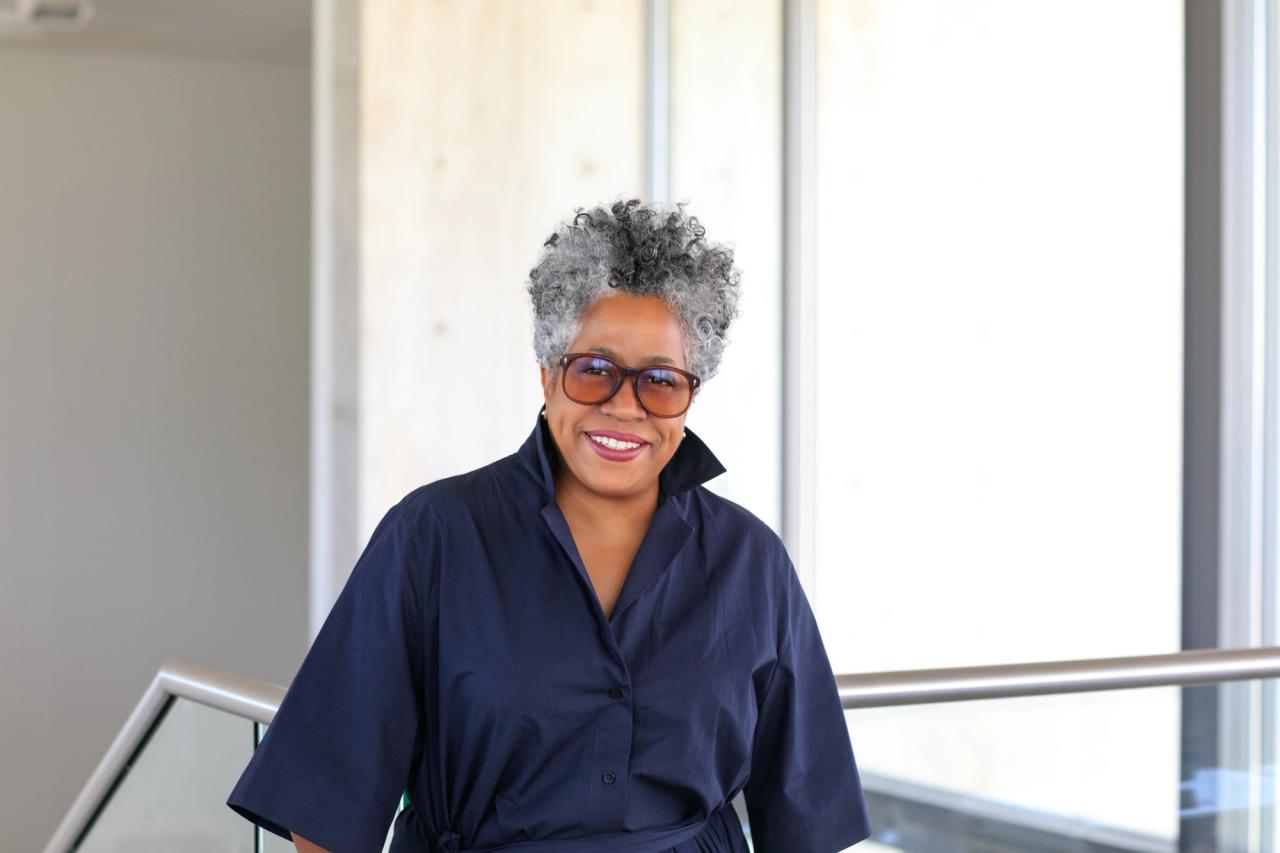
Jennie C. Jones (Photo: Suzy Gorman)
SPENCER BAILEY: Hi, Jennie. Welcome to Time Sensitive.
JENNIE C. JONES: Hi!
SB: I wanted to start today’s conversation with your exhibitions—two—that are currently on view at the Pulitzer Arts Foundation in St. Louis. One of which, “Jennie C. Jones: A Line When Broken Begins Again,” features a selection of your new and existing works: paintings, sculptures, works on paper, sound pieces. The second of which, “Other Octaves: Curated by Jennie C. Jones,” includes works you’ve selected by artists including Carmen Herrera; Agnes Martin, who I know is a hero of yours; Martin Puryear; Alma Thomas; and Mildred Thompson. Let’s start with the phrase “a line when broken begins again.” How did you land on that title for the show? What does that phrase mean to you?
JCJ: That phrase came from a piece of prose writing, actually. That’s in the book [A Free and Shifting Tonal Center] I published about two years ago with Radius. It was kind of my first big monograph, and it was pulled from… I have these fragments of texts that often get pulled from my sketchbook writing, that I swear no one will ever see but me, and then there’s these little juicy things that kind of slip out.
For me, it really was about this picking up of the gauntlet of my deep interest in my origin story into minimalism, how that folds into Blackness, how that folds into time and music history, and art history, and Black history. So it’s a bit about, overtly, about a timeline, in a sense. About when things break and start again, but also, on a microscopic level in music notation, in the break—like Fred Moten’s In The Break—or the spaces in between. How do you begin again, after you have this break, or this space in between? Are you continuing on, or are you shifting your register? So, I love working with metaphors, and I love taking these things in a lot of different directions. But slowly, some of the writings have been dripping out into titles and into other projects.
SB: I read your Radius book, and I feel like—
JCJ: Oh, my God.
SB: There are texts in it that one could read as poems. Maybe fragments is another form of it. I mean, they’re notations, perhaps. All of the above.
JCJ: Yeah.
SB: But they’re really beautiful, and I feel like they’re reflective of almost like the stream of… I felt like I was inside the artist’s head a little bit, reading those.
JCJ: For sure. Which makes me feel slightly insane, and slightly like, Oh, I do make sense when I’m muttering to myself in the studio? Then I’m like, I should write that down.
“There’s a poetic juice there still, in those intimate, private, process moments.”
And actually, there’s a poetic juice there still, in those intimate, private, process moments.
SB: So, this exhibition features your first indoor freestanding sculpture.
JCJ: Yes.
SB: It’s called “Point of Perspective,” which engages Ellsworth Kelly’s “Blue Black” wall sculpture that’s permanently installed in the same gallery.
JCJ: Yes.

Cover of Jennie C. Jones Catalogue (2026). (Courtesy The Pulitzer Arts Foundation)
SB: Being in dialogue with Ellsworth Kelly, I mean, in a way, this is such a full-circle moment for you. Could you speak about this across-time relationship with Kelly’s art, from your studies at the School of the Art Institute of Chicago, to your Hirshhorn Museum exhibition in 2013? How have you processed your Ellsworth Kelly time here? This is pretty fascinating. He was an artist who, I think we could say, is one of the more pivotal early art moments for you, perhaps?
JCJ: Sure. Yes. In a push-pull kind of way. I’ve written about that. Some of my writings that are more critical are going to be in the forthcoming Pulitzer book, a collected handful of essays. I wrote about Ellsworth in Art in America. Oh, my God, I can’t remember what year that was, 2010 maybe? I don’t know. But referencing that shift that happened for me at the Art Institute of Chicago, when his pieces were permanently installed, and hence the removal of a variety of other artworks. Not specific artists that I was like, “I can’t believe they took that down!” But it was just that one artist took over such a prominent amount of space, and that was when the museum was such that you had to walk through the museum to get to class, which was the cornerstone of that school. I won’t unpack the shifts and changes in art school mentality and academia.
So I’ve written about this anger, mixed with sort of a passionate jealousy, that he had the freedom to make the work that I wanted to make at the time. In the nineties, I was interested in surfaces and monochromatic work, and afraid to figure out what that meant in 1992, ’91. It was the peak of multicultural discourse. So there was a real sort of critique that has evolved since then, I think, of doing, in this case, with the Pulitzer, literally a dance of eclipsing, or playing with what it means.
“Over the years, my work has so pointedly been about art school, about deconstructing my relationship to art history: Where am I in these timelines?”
But also, over the years, my work has so pointedly been about art school, about deconstructing my relationship to art history: Where am I in these timelines? Versus avoiding it completely, or pretending like I did not—I’m not a victim of art school, like so many people with master’s degrees. I just don’t really want to talk about that part of how that enters the room, how that enters the studio, and how it enters your psyche.
When I walked into the Pulitzer, I knew that piece was there, but I didn’t really understand fully, until I was in that [Tadao] Ando space, how dominant it was. I have a picture I keep saying I’m going to post on Insta, where I’m literally doing the thing where you hold your thumb up, and you squint one eye and try to take something out of the vista in front of you. [Laughs] We cut pieces of paper to scale, and I held it up. I was like, “What the fuck can I do in this room, with this giant Kelly in the sight line, always? Except to address it.” I’m grateful that Emily Pulitzer was on board with it, because it’s her gift to that space, along with the other permanent artworks that will be there, so it’s a different kind of church feeling.
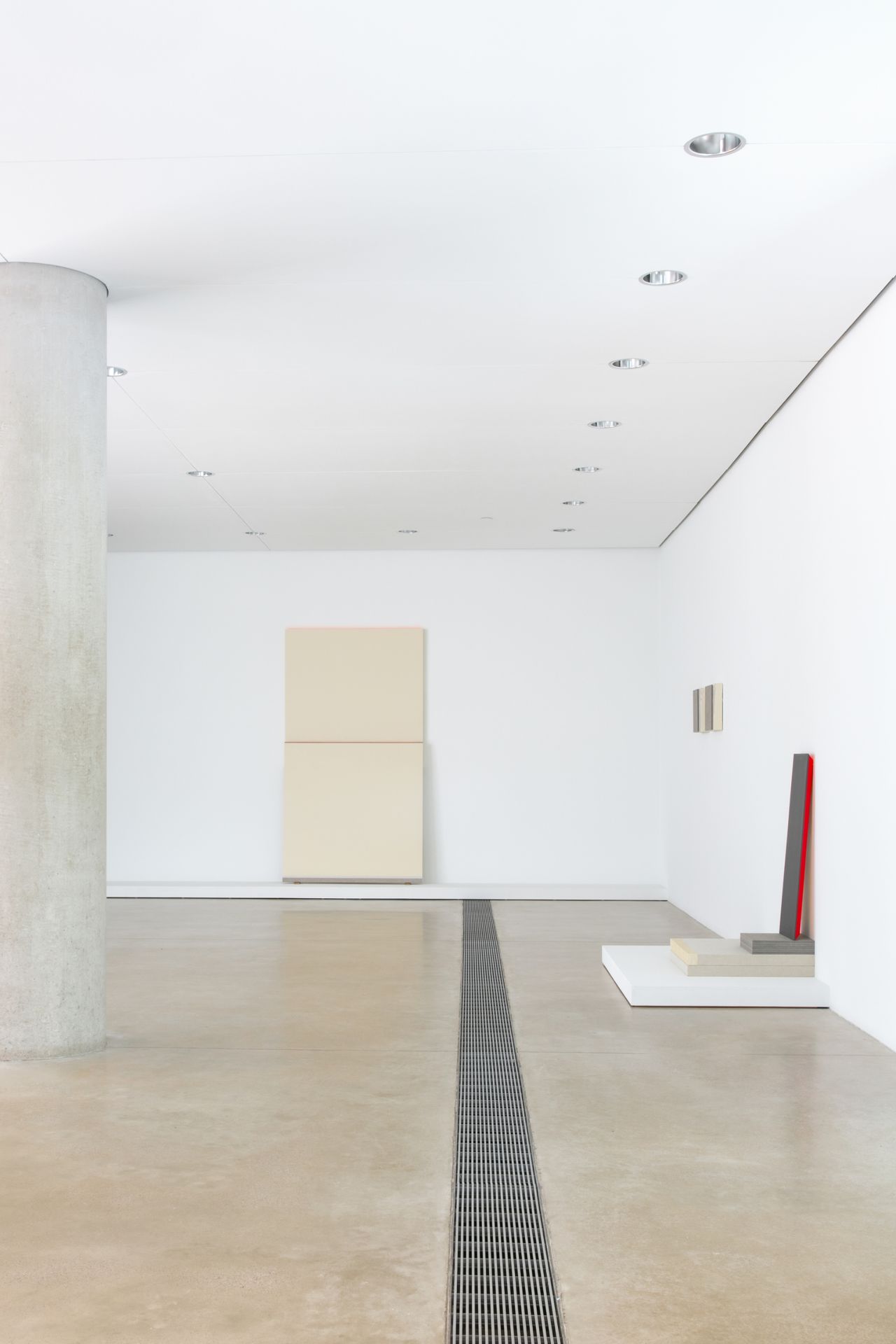
An exhibition view of “Jennie C. Jones: A Line When Broken Begins Again” at the Pulitzer Arts Foundation. (Photo: Suzy Gorman/Courtesy Pulitzer Arts Foundation)
SB: Yeah, it’s a difficult, tricky dialogue, right?
JCJ: Yeah.
SB: I mean, you’re toeing this line between, almost like, I don’t know if retaliation is the right term? There’s reverence and respect and retaliation, all at once. All of that’s happening there. Sort of an acknowledgment of, “This guy’s taking up so much space.” [Laughter]
JCJ: But also, can I eclipse him, physically, just for that brief moment? Because it is about how you move in space. Interestingly enough— This is a small side track. Fred Moten, when he saw the show (“Dynamics”) at the Guggenheim, right before we went to do a talk there, he mentioned this sort of weird choreography that my work creates, that the viewer moves around the piece, and you get on your tippy-toes to see the top, and where’s this weird hum color coming from? I work the edges of everything. So, you peek around the edges. There’s this thing that made me aware about how much the work is actually really about the body. Then, in the context of talking with Fred, the absence of Black bodies in my work as signifiers. But then there’s this manipulation of audience, because you want to come closer, and then you want to step back. You’re like, “Is that a speaker? Is it absorbing sound, or pushing sound at me?”
But the same kind of dance, and having that long, cathedral-like space at the Pulitzer, you really are… It is about movement. It’s about this long walk, and then the stairs that go down to the lower level. There’s a lot of choreography in the architecture, basically. There is a circular flow in the architecture, so the ability to eclipse or disrupt a sight line—there’s only a few moments in that kind of space where you can do that.
Needless to say, also I referenced in the book— it was Trisha Brown, the choreographer, whose work I came to know later also. Her performance, it’s called “Leaning Duets,” where she’s holding hands with someone, and it’s on the street in SoHo. The task is to hold hands and walk forward with your feet touching, and balance each other out in this beautiful kind of way that involves cooperation. I really thought about that, also, in terms of what the show on the lower level was doing, and how it was supporting this dance or coordination around my work, and how it engages with history, for better or worse. A little too, maybe art-siloed sometimes, in my thinking. But hopefully a general audience will also maybe get a little giggle out of it. [Laughs]
SB: Yeah. I wanted to ask the Kelly-time question, because it feels like it’s so interesting that Ellsworth Kelly has reappeared.
JCJ: Not intentionally, either! It’s just like, ugh. Yeah, it has happened. The Hirshhorn was the first time.

“These (Mournful) Shores” (2020) at The Clark Art Institute. (Photo: Thomas Clark/Courtesy Jennie C. Jones, PATRON Gallery, and Alexander Gray Associates)
SB: Yeah, you were wedged in between this Ellsworth Kelly—
JCJ: Their contemporary—
SB: … and Clyfford Still gallery.
JCJ: Yeah. Their project room for contemporary living artists was between the Ellsworth Kelly room and the Clyfford Still room. So making a sound piece that would bleed into both of those spaces, and interrupt people viewing these other artists, was part of that mission. To really lean into how sound bleeds, and it can sort of rupture someone else’s concept of, view of, looking.
SB: You’re also engaging the architecture of Tadao Ando, and this is an architect who designed the Clark Art Center in Williamstown, Massachusetts, a building you’ve been in dialogue with previously.
JCJ: Yes.
SB: Could you speak about your engagement with these Ando structures? And also, share a bit about the Clark project, “These (Mournful) Shores,” from 2020.
JCJ: Yeah, I think the Clark was a prompt, in a weird way. Like a flare shot from Western Mass, to the Pulitzer, and to the Met. It was just like, “Can I take that project and split it in between two overwhelmingly important institutions, that’s going to cause anxiety for three years? Yes, you can. Yes, that can happen.”
The Clark was, I think it was six women in the landscape, and the timing was painful, because it was Covid. But then, the timing was magical, because it was all this outdoor work. The Clark is a beautiful Ando building, the land, the grounds are open, so people were able to walk the landscape during some of the darkest times in Covid. I felt like that was a real honor and kismet, great timing to be able to have something that generative in the world.
I remember when we went to look at the locations that the curators had, once you’re up high, and you have the sight of that entire building… I just wanted to crawl back to the architecture so bad. I kept making jokes about how I’m not an outside cat, and I don’t know why you want me to be in this landscape show, because it’s not what I do. [Laughs] I’m not going to put up a solar panel and have something activating sound. All of that sort of extra materiality that comes with, “How do you make sound happen?”
I ended up investigating Aeolian harps, and the call of the Clark’s collection, and the Homer paintings are a sight line from the edge of that Ando wall, across the water into the first gallery that you see coming in, through that side of the patio there. It was like this call and response. “These mournful shores, these mournful shores” was also something I wrote down, looking at these paintings of the Atlantic, and what I bring as a person of color, looking at a turbulent Atlantic. It made me think of Paul Gilroy— So much writing and discourse about the diaspora. When I’m looking at an ocean painting, I’m thinking about these other things that are… loaded.
SB: And you’re thinking about, as your work so often does, Black music. Moses Williams and Louis Dotson, in particular. I didn’t know these musicians. This is another magical thing about your practice, the way you elevate others’ voices.
JCJ: Absolutely.
“One thing I love about the way I work, which is kind of weird, conceptual rabbit holes that I can fall down, is that all of that sort of juice—what old Black folks would call the potlikker, the roux in the bottom of the pot—everything gets distilled down to this richness.”
SB: But these two musicians performed on what they called a wall harp—it’s commonly known as a monochord.
JCJ: Yes.
SB: And you sort of did your own massive, large-scale evolution of that, let’s say.
JCJ:One thing I love about the way I work, which is kind of weird, conceptual rabbit holes that I can fall down, is that all of that sort of juice—what old Black folks would call the potlikker, the roux in the bottom of the pot—everything gets distilled down to this richness. And then you can build off of that, and build off of that. What’s the difference between thinking about a Fred Sandback, and thinking about Louis Dotson ? And What’s the difference between thinking about Richard Tuttle’s wire works, and thinking about its intentionality, its cultural history, its necessity and utility? That became another way of— I always weirdly feel like I have to bolster up my interest in minimalism, and if I can keep finding a richness that my sort of superpower origin story actually has these tangible, fantastical things, these gifts to offer. Who looks at a fucking broom and says, “I’m going to take the wire off of that broom, and I’m going to pin it on the side of our house, because we have nothing. And I’m going to tune it. And everyone’s going to come and stand around, and sing and listen, and be inspired and joyful”?
SB:Moved.
“Sometimes it is just this gesture that is purely about improvisation with materials around you, and how to make sound shift the energy that might be pretty complicated, and low, and hard, and how to elevate that.”
JCJ: And the sound. That is the core of Black sonic practitioners, and all of their abstraction, and all of their complicated histories. Sometimes it is just this gesture that is purely about improvisation with materials around you, and how to make sound shift the energy that might be pretty fucking complicated, and low, and hard, and how to elevate that. But not for an audience, not like the postwar music industry, big machine that we have now, which cranks out—
SB: No, it’s raw. I mean, I listened to this Moses Williams song this morning, before this conversation, because I was like, I want to dig into some of this music, and that is what I could only describe as felt music.
JCJ: Absolutely.
SB: I mean, it’s almost tactile. You can feel him plucking that string.
JCJ: Yes. And it sounds, also, like multiple people. It’s like throat singing. You’re like, wait, he’s tapping his foot. He’s playing the bottom, near the can, and he’s playing the top all at the same time. It sounds multilayered.
SB: If we can figure out the rights, I want to excerpt a minute and a half of that song, here. [Plays an excerpt of Williams playing “Sitting on Top of the World”]
JCJ: I did use that as a springboard for the Met playlist. That, out of the gate, was [an early recording of Moses Williams’s interpretation of] “Sitting on Top of the World.” Look at where that piece was, and Moses singing, “I’m sitting on top of the world.” But then it went deep into all of those avant-garde composers, that are ninety percent. I was so nervous that the Met was going to get hijacked into this “banjo on the roof, porkpie-hat” thing. I mean, I was terrified for years. I was like, “It cannot be this reductive. It’s an institution that has to send a clear message about what the project is.” So that is another challenge, if the work is so complicated.
SB: I mean, this is a whole sidebar, though. It’s like, I’m glad we have the opportunity and the time to have this nuanced conversation. I feel like your work in particular, let alone tons of art, can just be reduced to the most basic conversation. But there’s so many layers, there’s so much richness there. I think we’re living in this weird moment in time and technology and culture and society, where all these interlocking things are creating this dumbing down.
JCJ: Yes. It’s folded together. The scrolling, and the mash-up of history and information, becomes just irrelevant from its context. You’re looking at ten different historic moments in five seconds, as something else. I think listening is that way, too.
SB:One of the things about your work that I want to talk about today, which you’ve said, is: “There’s a big difference between site-responsive and site-specific work.” I feel like that extends out of what we’re talking about, which is, how do we respond to space? How are we actually feeling its reverberations in real time, and being in physical space with one another, with art?
JCJ: But also, responding to the history of the location that you’re in, or the building, or the architecture. There’s so much working in a vacuum right now.
SB: The context. The Ellsworth Kelly on the wall.
JCJ: Yeah.
SB: I want to turn to “Other Octaves,” this other exhibition. What was it like to bring this show together and to essentially be the curator?
JCJ: It was a dream. The Pulitzer, Stephanie [Weissberg, senior curator at the Pulitzer Arts Foundation], the team there was so supportive in finding works that we could borrow, which is not easy. It’s a time, speaking of time, it’s a process that artists aren’t on the other side of very often. So, loan letters go out a year and a half before. It really just is like: If I could magically think about everyone I would want to invite to have to the dinner, whatever that cliché is, where everyone comes and sits at a dinner, it would be this cohort of people.

Louise Nevelson’s “Untitled” (1972). (Copyright Estate of Louise Nevelson/Courtesy Artists Rights Society)

Agnes Martin’s “Untitled” (1963). (Copyright Agnes Martin Foundation/Courtesy Artists Rights Society)
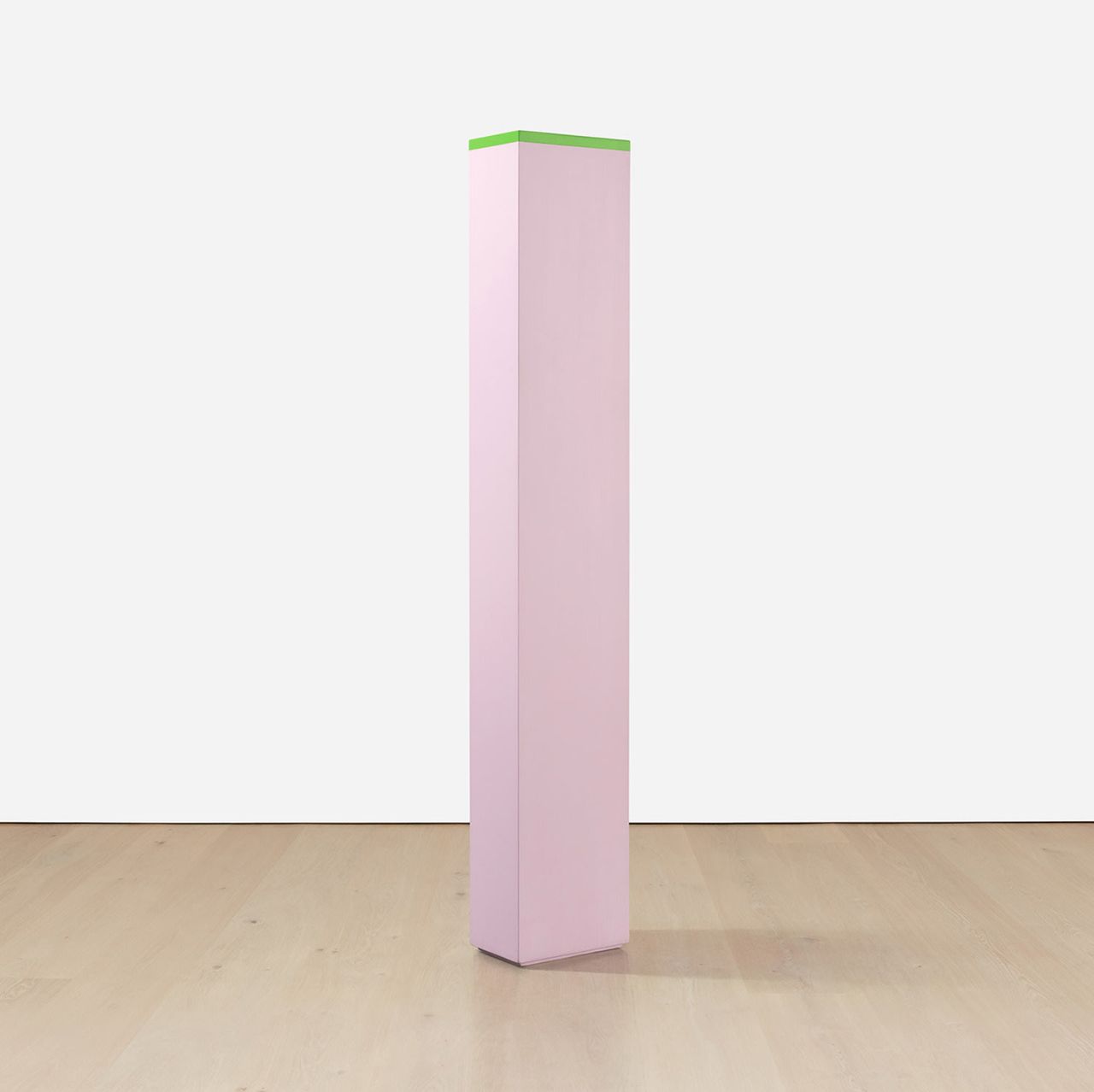
Anne Truitt’s “Spring Dryad” (1975). (Copyright estate of Anne Truitt and Bridgeman Images/Courtesy Matthew Marks Gallery)

Zarina’s “Wall” (1969). (Copyright Zarina/Courtesy of the artist and Luhring Augustine)

Fred Eversley’s “Untitled (parabolic lens)” (1970). (Photo: Suzy Gorman/Copyright Fred Eversley)

Martin Puryear’s “Métissage/Camouflage” (2016) (Copyright Martin Puryear and Universal Limited Art Editions)

Hanne Darboven’s “Month III (March)” (1974). (Copyright The Museum of Modern Art/Licensed by SCALA/Art Resource, NY and Copyright Hanne Darboven Stiftung/Courtesy Artists Rights Society)

Benjamin Wigfall’s “Nine Part Black Theme” (1971). (Photo: Travis Fullerton/Copyright Virginia Museum of Fine Arts)
Louise Nevelson’s “Untitled” (1972). (Copyright Estate of Louise Nevelson/Courtesy Artists Rights Society)
Agnes Martin’s “Untitled” (1963). (Copyright Agnes Martin Foundation/Courtesy Artists Rights Society)
Anne Truitt’s “Spring Dryad” (1975). (Copyright estate of Anne Truitt and Bridgeman Images/Courtesy Matthew Marks Gallery)
Zarina’s “Wall” (1969). (Copyright Zarina/Courtesy of the artist and Luhring Augustine)
Fred Eversley’s “Untitled (parabolic lens)” (1970). (Photo: Suzy Gorman/Copyright Fred Eversley)
Martin Puryear’s “Métissage/Camouflage” (2016) (Copyright Martin Puryear and Universal Limited Art Editions)
Hanne Darboven’s “Month III (March)” (1974). (Copyright The Museum of Modern Art/Licensed by SCALA/Art Resource, NY and Copyright Hanne Darboven Stiftung/Courtesy Artists Rights Society)
Benjamin Wigfall’s “Nine Part Black Theme” (1971). (Photo: Travis Fullerton/Copyright Virginia Museum of Fine Arts)
Louise Nevelson’s “Untitled” (1972). (Copyright Estate of Louise Nevelson/Courtesy Artists Rights Society)
Agnes Martin’s “Untitled” (1963). (Copyright Agnes Martin Foundation/Courtesy Artists Rights Society)
Anne Truitt’s “Spring Dryad” (1975). (Copyright estate of Anne Truitt and Bridgeman Images/Courtesy Matthew Marks Gallery)
Zarina’s “Wall” (1969). (Copyright Zarina/Courtesy of the artist and Luhring Augustine)
Fred Eversley’s “Untitled (parabolic lens)” (1970). (Photo: Suzy Gorman/Copyright Fred Eversley)
Martin Puryear’s “Métissage/Camouflage” (2016) (Copyright Martin Puryear and Universal Limited Art Editions)
Hanne Darboven’s “Month III (March)” (1974). (Copyright The Museum of Modern Art/Licensed by SCALA/Art Resource, NY and Copyright Hanne Darboven Stiftung/Courtesy Artists Rights Society)
Benjamin Wigfall’s “Nine Part Black Theme” (1971). (Photo: Travis Fullerton/Copyright Virginia Museum of Fine Arts)
“What was most important for me, being so obsessed with the confluences that happen in art history, and history in general, is that there’s so much crossover.”
What was most important for me, being so obsessed with the confluences that happen in art history, and history in general, is that there’s so much crossover. Anne Truitt writes about Martin Puryear coming to her opening. We would never put them in a show together, but they were in the same moment. There’s a lot of that. We separate these communities into “sculptors,” into “women artists,” into “African American cultural producers,” we put them all in these separate places, but they were all in the same historic moment.
SB: I should mention: I did say I was listening earlier to your Met playlist, but you also made this Pulitzer playlist called “Stay on It.” The title track is a Julius Eastman [song] that I’ve listened to, probably, at least a dozen times over the past forty-eight hours. [Laughs]
JCJ: It’s so good.
SB: It’s hypnotic. To the listeners who don’t know this track, if you haven’t heard it, you should go listen to it. Maybe also, if we can get the rights to it, we’ll put it on the podcast, or at least—
JCJ: I feel like it should [be] an anthem for right now, too.
SB: I think we should, if we can, we’ll put a pause right here and put this track on the episode, just to give people a moment. [Plays first minute and 50 seconds of “Stay on It,” as performed by Wild Up]
Could you talk about your love of this song, and Julius Eastman’s music? It’s in the exhibition, right, as well?
JCJ: Yes. I purchased the score, and I got all these copies, because it was actually for an orchestration, and I didn’t really know how that worked. It’s amazing to have thirty-five copies of a score. It’s a great gift to share with musicians, and friends that are readers, as well as players. But it was actually the show with Glenn Ligon at 52 Walker that reignited the fact that I was like, “Wait, I should have, he should be…” I was working on the Pulitzer at the time, and I did a lot of listening.
The lyrics, the opening poem for that piece, is never performed anywhere, ever. I couldn’t find it on a recording. It’s usually just the music score. I was laughing with Glenn, actually, because also, I think it’s just so of its time. It’s like, “Stay on it, baby!”
SB: [Laughs]
JCJ: There’s a beautiful sentence that I’m going to totally screw up, which is, “Stay on this invisible thread, until it becomes tangible.” [Editor’s note: The lyrics are, “Change this thread on which we move from invisible to hardly tangible.”] Or something about intangibility, and staying on a tender thread, and it felt like this is also the timeline thing that goes on.
SB: It’s like repetition, and there’s this phrase, “Stay on it, stay on it, stay on it.” It’s going over and over again, until it becomes real.
JCJ: Yes. But it feels like right now. It feels like the urgency of right now, to me. We all need to stay on it. We need to stay on our mindfulness.
SB: Listening to it—and I hope this isn’t too much of a stretch—but I felt like I really saw the direct line to your work.
JCJ: Wow.
SB: That song. And the pauses, the in-betweens.
JCJ: It’s like stopped time.
SB: … those sort of breaks.
JCJ: When you talk about time, I love stopped time. I get fascinated with songs that have stopped time in them, where there’s a hard gap.
SB: What’s your process for putting together a playlist? Because I think most people, of course, know you incorporate sound, and you are a sonic practitioner. But from a playlist perspective, how are you—
JCJ: I think with the Met, I was more conservative. It was different; it’s kind of play to audiences, too, with playlists. The Met was not a line starting by decade, or anything, but it certainly opened up to a breath where we start with that. And go through, mostly Olly Wilson, who I had the pleasure of meeting at the American Academy in Rome, who was the head of the music department in Berkeley for many years, who’s a Black composer that a lot of people don’t know about very much. He did some experimental work with tape. So, “Sometimes for Tenor and Tape”—there’s some really beautiful works that I just want to share.
“Playlists function like writing, or titles, or wall texts. I can be self-indulgent and full of refusal, in a way, in the work, and distilled. But then, there’s cracks into where this is taking you.”
I think playlists function like writing, or titles, or wall texts. I can be self-indulgent and full of refusal, in a way, in the work, and distilled. But then, there’s cracks into where this is taking you. Someone can read a title of a piece that appears to be just a solid fucking form that’s going to sit with you, but maybe there’s this other path that’s folded in, that lets you go.
The Pulitzer playlist was fun. It feels like more what I would listen to right now. Not necessarily scholarly, but it’s more sixties-seventies leaning, but experimental, like Maryanne Amacher, for when pieces were like thirty-five minutes long, and it was okay. Even Arthur Russell, or a lot of younger, synth-y, Japanese ambient type of stuff.
SB: Well, I love that there’s this movement happening right now, where people are… It’s been like this in Japan forever, but now in America, people are like, “Listening bars.”
JCJ: Oh, I know.
SB: There’s this sort of return to the analog, and the tactile, and people are understanding that the way we listen on Spotify is not the way…
JCJ: Yes.
SB: I feel like your work, while not interrogating that directly per se, it is also connected to that. There’s this— It’s how do you engage the tactile through sound?
JCJ: Yeah. I mean, I used to. The work from, I’d say 2000 to 2007, was really mourning analog. I had made works where it was like, “The death of analog!” Like this photograph, the story is that there was literally a car with a trunk open, in Brooklyn turned a corner fast, and just dumped all these fucking jewel cases of CD cases, all over the street. I go outside and I was just like, This is it. This is what is happening. People are dumping their CDs and their computers, and there’s just boxes of CDs on the street everywhere. We’re downloading all of our stuff. [Laughs] But what was left was just this carnage of materiality. Like, “I don’t have to walk across the room anymore. I’m not walking across the room to pick up a needle. I’m not having the moment where I have agency, and I make a decision about what to listen to next.”
SB: I haven’t thought about it in a long time, but this was Napster, right?
JCJ: Totally fucking Napster.
SB: It was Napster, and then, of course, the iPod and the iPhone.
JCJ: And you can keep fifty songs.
[Laughter]
SB: Well, I will say, to the listeners, go check out her playlists, because they are really interesting. I think I listen to some pretty avant-garde, weird music, but it was very enjoyable to discover these new artists that I wasn’t familiar with.
JCJ: New-old artists. This is the time loop.
SB: Yeah, new-old, or Gil Scott-Heron, I think, who we all should listen to more, whose work I love. The Vernon Spring is an incredible group that appears on some of your playlists. A newer, younger artist, actually, Nala Sinephro, whose work I think is just extraordinary.
JCJ: I was trying to find, “Who’s young and doing anything with a harp or pedal harp?” That was delightful to discover her work.
SB: So, a lot’s been written and said about your work from an architecture-and-sound perspective, and we’ve even talked a little bit about that today. But I wanted to really bring time into this equation. Maybe we could speak to a particular work—this is maybe on the nose, but you had a work in your Guggenheim show called “Fractured Extension/Broken Time,” and it’s a diptych composed of two square panels, each four feet wide by four feet tall. I was wondering if you could speak to either that particular piece, or just generally, how you think about time being this third element in the architecture-and-sound equation.
“All of this thing about broken time is also very personally this heartache of familiarity, of where we are, again and again. Both having micro/macro, both having the same kind of broken conversations about the same issues, from fifty years ago.”
JCJ: Wow. Yeah. So, “broken time” is one of my favorite terms in music notation, because it just feels like it resonates on all these other levels. I started working with this slash of crescendo/decrescendo, and it’s still just grinding away at me. I can’t let it go, because it becomes something else. It shifts, like lines shift. So when they become broken, when the crescendo is broken, or when it’s going down or up… All of this thing about broken time is also very personally this heartache of familiarity, of where we are, again and again. Both having micro/macro, both having the same kind of broken conversations about the same issues, from fifty years ago.
SB: Yeah, I mean, Saidiya Hartman would call it “temporal entanglement,” right?
JCJ: There we go.
SB: I mean, it’s like it reappears, and it reappears. You think it’s gone, and then, there it is again.
JCJ: Yeah. And here we are living through [laughs], well, an authoritarian fascist movement. “Oh, yes. No. Here we are.”
SB: Well, also connected to this broken time, there tends to be these moments that get very heightened, and then there are these moments of pause. I think it’s fair to say that absence and pause and rest are central to your work.
JCJ: Absolutely.
SB: “The fugitive center,” as Fred Moten describes it. There’s a certain slowness to your work, too. I’m not just talking about the making—we could get into the long, slow arc that is your practice. But in a conversation with the critic, editor, and scholar Huey Copeland about a decade ago, you said, “I think everything is just so fast and intense these days. So first, it really is about getting the viewer to stop. And then to ask very simply, ’What is that?’”
Can you speak to this a little bit? Because I think there is this… I mean, it was relevant then, in 2015. But I think in 2025, it feels like hyperspeed.
JCJ: Warp speed. Yeah.
SB: Like, post-Covid, the sort of, “What is that?” The “fugitive center,” creating these spaces for slowness and pause.
“I think we’re hitting a pivot point where people are starting to crave slowness.”
JCJ: Yeah. Like you were talking about with these listening spaces, I think we’re hitting a pivot point where people are starting to crave slowness. And some of us have struggled the whole time, but maybe now it’s Gen Zers or something who are just like, “Wait, what’s happening, if I put my phone down, or unplug, or sit on the floor with ten people?”
SB: Drink less.
JCJ: Yeah.
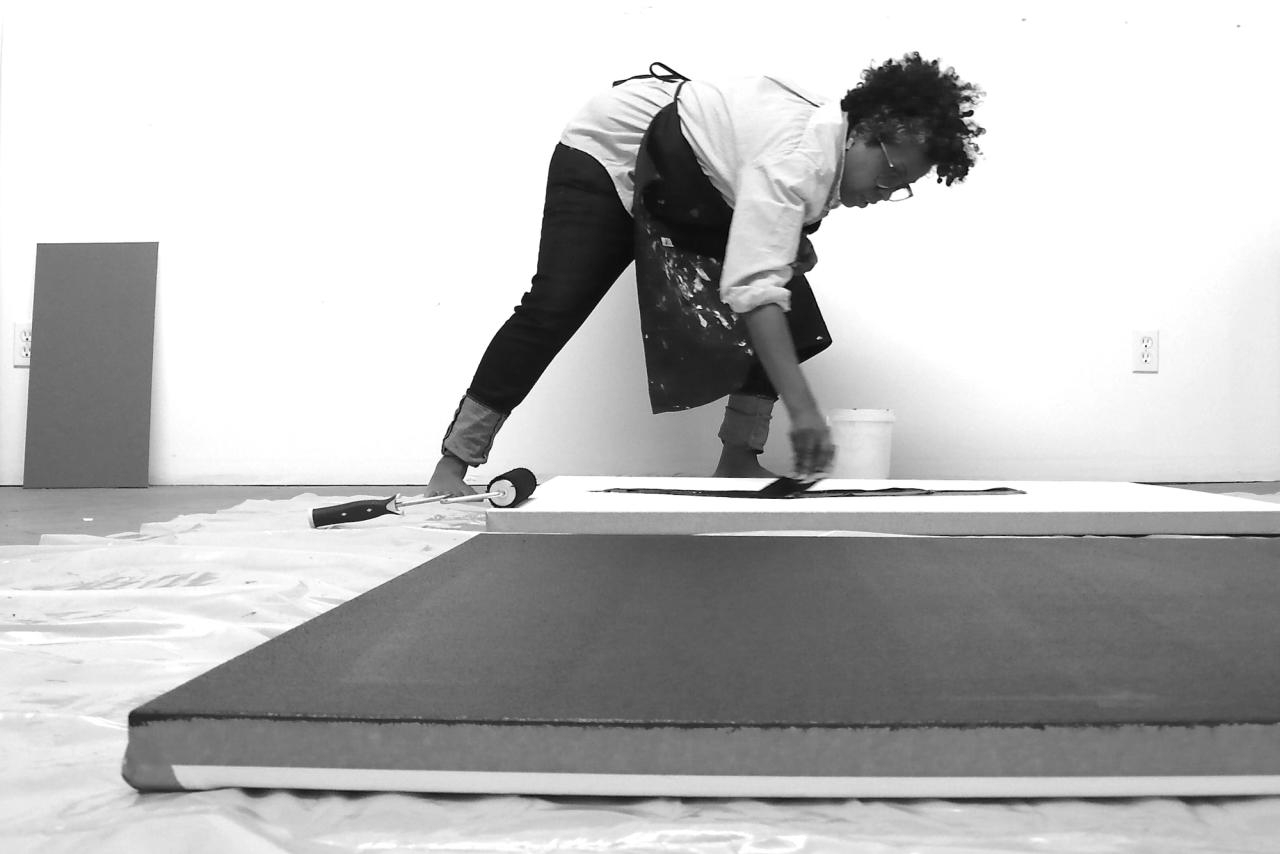
Jones in her studio in 2013. (Courtesy Jennie C. Jones)
SB: All of it.
JCJ: All those eighties things, man. I was, like, in high school. Oh, my God.
SB: But there is this idea of restraint, or this—
JCJ: Yes. But I always equated it with sort of a level of resistance, in my own way. I do feel like one of my biggest things is— “The Theater of Refusal,” for example, came back into vogue, which is Charles Gaines’s exhibition curated with Catherine Lord. I have the book. I found out the catalog that I’ve kept for thirty years is now actually worth some money, but all to say, what a beautiful title, anyway. Just the crux of “The Theater of Refusal,” this kind of thing in the world that refuses to be pinned down, or defined. The problems, the troubling that that can make. I’ve had Black collectors say, “Well, I didn’t know that you are a person of color. I would have…” And I’m just like, “Well, are we going to parse it out? We parse out our aesthetics in this way, where if there’s not a signifier, one collector should not be interested or is interested?” Because the inverse is very true, as well. Obviously, white collectors needing to, say, point at the thing in their house.
But all of this is, it troubles the way that people… it becomes an interloper in the studio when it should not be. So, for the last three decades, I’ve been hyperaware of it, and also just like, “No, this is my authentic shit,” since I was in undergrad looking at a Kelly, a black Kelly. And thinking, If I make a black painting, it’s got a whole different meaning, immediately. So what is that about? Well, then, what is my relationship with Ad Reinhardt? What happens when Agnes [Martin] makes a couple of heavy black paintings out of nowhere, like once a decade? What are those anchors about, in her oeuvre? And what does that mean? “Dark corners” is what I talked about, with the Dia talk.
There’s all of this sort of feeling of, not just saying to Huey, like someone pauses and says, “What is that?” But also my awareness of what the studio is, of being selfish, and defining my own methodology and my own path, which has been one full of institutions, but far from a profitable… [Laughs] I have to make that joke. I think my nieces and nephews are like, “Oh, you had a show at the Met, you must be a millionaire now.” I’m like, “No, that’s not how it works, kids.” [Laughter] I took it to trash level, right there. But after all that, poetics.
SB: [Laughs] Well, I think that there is a refreshing thing about you and your work, which is that, in a world in which everything seems like it should be so defined, or taking itself so seriously, your work is rigorous. It is serious. But there’s a kind of lightness, too.
“It’s such a psychological thing to make a red surface. You feel like you’ve wrangled a beast by the end of it.”
JCJ: Yeah, for sure. Absolutely. I mean, it’s pleasurable for me. It’s like a battle in the studio, sometimes. And I think— I don’t remember who I was talking to. I thought, If people only knew the violence behind those red paintings, because it’s such a psychological thing to make a red surface. For me, that would be four feet by four feet is enough. You feel like you’ve wrangled a beast by the end of it, washing red paint off my hands and just being like, “Ah.” And then it gets soothed over, and coated over. So I talk a lot about pentimenti, and the private expression underneath some of these paintings, before they get covered with acoustic material, or coated over and over and over. It’s labor-intensive to get it to that place of quiet, so it does balance out between wild gestures and then taking that away from the viewer and distilling it down.
SB: Quiet rage.
JCJ: Quiet rage. Yes. [Laughter]
SB:Speaking of slowness, I wanted to bring up two sound works, earlier pieces of yours, “Slow Birds,” from 2004, and “Slowly in a Silent Way, Caged,” from 2010. Could you speak to these works, which really kind of riff, and think a lot about, and improvise upon, I guess you could say, Max Roach and Charlie Parker, in the case of the first one, and Miles Davis, in the case of the second?
JCJ: Well, the underpinning, I will say, is that, over this long arc, I really did start with unpacking postwar. It’s postwar to the present—this is how we define sort of a Western art history narrative. And then, looking at every single rupture, every decade, of who is rupturing this narrative? And where can I get inspiration and juice and support? Again, this idea of origin story, giving me the freedom to do whatever the fuck I want, and say there’s precedent everywhere, all the time.
So, I was a hard bop listener in the nineties—like, nerd alert. Ah, what was the name? There was a show called “Bird Flight” that was on early in the morning, on NPR. And it was just all Charlie Parker, way out of the… “This is a 78 that doesn’t even exist that was my grandfather’s.” All of this amazing stuff.
SB: Deep cuts.
JCJ: Deep, deep cuts. So then I got obsessed with Dean Benedetti, who was obsessed with Charlie Parker, and quit the instrument just to follow him around and make recordings of him everywhere. Running a wire, in the clubs, into the bathroom stall. It was during the war, so there were only paper tapes, and they were like the holy grail of Charlie Parker, because there was a music strike, so there were no records being made, and all of his early formations were not recorded, except for this kid. They found them in San Francisco, in a building, and they became these lost tapes.
So that kind of made me rethink, how do I get to “Slow Birds”? So I get to “Slow Birds” through all of this, which no one would know for a five-minute, four-minute sound piece. I take the first couple of notes of “Koko,” which is a famous song where he’s with Dizzy [Gillespie], and it’s like lightning, breakneck speed tempo, that was the whole thing. “I want to play fast enough that white people can’t play this.” That was Bird’s thing. I slowed it down, and I stretched the time, stretched it out into this way where it becomes tonal. What was interesting was, he was so proficient. There’s not a crack in the tone. His tone, playing, was so smooth that when you see it as a sine wave, it is completely smooth. This is his breath. It just kind of opened up this other conceptual way of thinking about what breath and time signatures look like when you’re visually looking at them, when you’re editing sound, and you see how smooth. You’re like, “This is a virtuoso, that’s what that is.” If you can take three notes and there’s not a break from his lungs that is causing any kind of woo.
And then the Miles Davis piece was just kind of like, if you say jazz, people say, “Miles Davis.” If you say you’re a sound artist, people say, “John Cage.” [Laughter] You have to sort of exercise your one John Cage piece early on, and get it out of your body because it’s just going to be there, somehow. So the opening chords of Herbie Hancock, playing In a Silent Way, before, Miles isn’t even on it. He’s absent. But again, to change the time. That is four minutes and thirty-three seconds, and it would alternate speakers. So one speaker would be silent for four minutes and thirty-three, and then it would move back and forth.
Again, for the time, for 2004, it was like this kooky, “What are you talking about, even?” Which we would say is a basic—it’s not a complicated formula, it’s a witty, nerdy formula underneath this. All made in SoundEdit 16.
SB: [Laughs] Well, you’ve described what you do as a sort of sonic practice.
JCJ: Yeah.
SB: I was wondering, because you’ve also been thinking about it, I guess you could say, this “listening as a conceptual practice” idea, which was something you wrote in one of your notebooks. What does listening as a conceptual practice actually look like in action? Could you describe your process a little bit?
JCJ: It’s a perfect segue, because I think it’s what just happened. I was listening and listening and listening to Bird. It became something that was embedded in my conceptual way of thinking about my work. And then, it evolves into a piece. I feel like, with conceptual work, the biggest clichés are maximalist and minimalist. You either take everything away, until it’s something, or you pile everything up, where it’s maximalist. When you start listening and thinking, “Which bucket can I put this in? Or, How does this connect to either sitting still, being quiet, or being overwhelmed? Or, how can you figure out how that works?” For me, it was listening with the intention of mining material, basically. But also, paying attention to how I feel, and maybe there are some things that are just totally untouchable, and they’re just for you when you’re in a room, by yourself, and it’s not to be messed with, at all. That is the other end of the spectrum, for sure.
“Musing by yourself in a room on paper is often better than the public speaking for many of us introverted extroverts.”
SB: There’s so many different ways of phrasing it, “deep listening”… But I would say, in researching this, I came across this quote of yours that I feel like really captures beautifully the sentiment, and I wanted to read it back here, which is, “I would say it’s a form of mindfulness, a deep, immersive pleasure you can have in those moments when you’ve abandoned your other senses and you are in it, you’re listening to something and its washing over you or you’re feeling the reverberations in your chest—it’s physical. For me, those embodied sensations also come with a real heavy sense of conceptualism and history.”
JCJ: Absolutely. Well, I said it better. Man, you can just cut everything I… [Laughter] I’m better on paper. I often feel like, to that end, musing by yourself in a room on paper is often better than the public speaking for many of us introverted extroverts. [Laughter] Thank you for reading that.
Jones’s dachshund (and only former studio assistant), Nina (2006–2024). (Courtesy Jennie C. Jones)
SB: Staying on music, and this sort of practice you have of researching, and lifting up, I would say, a lot of these voices,it’s such a diverse assortment. It’s not a grab bag. It’s very selective, but it is from Arvo Pärt to Melba Liston to Elvin Jones to Ray Brown. I mean, it’s all over the place, in a beautiful way. From a time perspective, what’s it been like for you to spend so much time with the work of these other artists?
JCJ: It’s a real gift. I think that when I was teaching and I would make references or, “You should look at this person, or have you read this book?” A lot of times, there’s a shutting down, an eye roll. I would always say, “Listen, you’re going to find your spirit animals. You’re going to find your compadres in history, over time. You’re not going to be a unicorn that invents something. It’s not going to happen. You need to bolster up your ideas with kindred spirits, over time.”
Often the thread is only this radicality, right? That way of time traveling, because it’s delightful, and interesting. It’s also maybe just to get the courage to say, “Well, fuck everything I’m doing, because look at how they shifted things.” And maybe it was just a personal shift enough to find that courage, to depart from what your peers are doing, or what you feel like you should be doing.
To that end, I will say that the vacuum, not weaving in and out of history, and not being mindful of a pedagogy, can lead to the Etsy shape-makers. It was called, a few years ago, “zombie formalism.” And that was devastating, because it took so much rigor to get to a place of distillment. I hope that you can feel it, and I think that you can feel it, the difference between those two things. The difference between a piece that has the texture of knowledge around it, or information. I think musicians also, if you quote someone in a song, and then you take off, and then you’re improvising. People remember the echo, the little quote of so-and-so that you play at the beginning of the song, but then you’re deep in someone else’s territory. And that is sort of an important thing.
I just had this thing where I worked with ICE, the International Contemporary Ensemble, for the Met. During the rehearsal, George Lewis, another hero, a MacArthur genius, wrote about the Association for the Advancement of Creative Music (AACM) in Chicago. There was a moment in rehearsal where he just paused and he said, “I noticed some of you, there’s definitely this call and response thing.” And he’s like, “You know what? Sometimes, it’s call and no response.” I think it stuck with everyone for many days. I was like, “This is why. This is why music theory, and thinking about time, thinking about how things are structured sonically, are the richest and best metaphors.” It’s like, “So somebody’s doing this. Fuck. You don’t have to fucking even reply. [Laughs] You can still hold your space and your own way.” So that was a recent George Lewis idiom mic drop, because he’s really good at that.
SB: Well, I love hearing you describe this, because to me, we live in such an obsessive visual culture. But one of the things your work does that I think is really essential to the conversation, is it makes people think about that through line of the visual and the aural, the audio, the sonic. There’s this thing that happened when I was preparing for this, where I was listening to these playlists that you had structured, or organized. Looking at your work, or at least reproductions of your work in your books, at the same time, and feeling this sort of overpowering sensation, that would have been totally different, if I was just looking at the work in the books. There was something about this combination of the music and you in conversation with these musicians and artists. And then to be looking at this sort of outpouring of your practice on the page… I have to say, it’s funny because normally I’m not listening to a playlist organized or created by an artist, or an author while looking at their work, or reading their book.
JCJ: Right.
SB: [Laughs] But it felt like this sort of full, sensory experience that allowed me to understand and interpret your work in a totally different way than I would have, if I weren’t listening to the music.
JCJ: Yeah. It’s like seeing the Cliff Notes, or the homework I did the night before I went to the studio. But there’s also this thing with sound art, where you don’t want to make a soundtrack for your show, and that’s also the push-pull thing.
SB: Oh, tell me about that.
JCJ: Well, I mean, I think the work that’s at the Pulitzer now is another, and the work that was at the Guggenheim. I really got to a place where it was… I always give silence. There’s nothing that’s on a grinding loop, because it’s just not fair to people.
SB: Especially the guards.
JCJ: Especially the guards. I know, oh, my God. But also, to make work that leans into the space; work that people can come in and out of. You can stand there for two seconds and kind of get an idea of what it is, or you can sit on the floor and listen to three cycles of something on a loop, but the loop is like ten minutes. Whatever. But just to be that generous, in how you can float in and out. I remember video art was like, you see a black curtain hanging in the gallery and you think, “Oh my God, am I going to go in that curtain?” And then there’s beanbags on the floor. “Should I sit?” And maybe it’s just me, one of those special people that’s like, “I don’t know how to navigate this.” Or headphones…
SB: No, you’re not alone. You’re not alone. [Laughs]
JCJ: … tethered to the wall. And then you’re like, “I don’t even know how long this is. Do I have to sit and watch a forty-five-minute movie? What is happening?” So, that push in the nineties, 2000s, where media was in the gallery. It was white box, black box, smash-up, and no one knew how to do it. I think sound art was a victim of that. You either walk in, you’re looking at wires and a speaker on the floor, and then you’re like, “Do I stare at the speaker? Where’s my body right now? ” The headphones tethered to the wall thing, all of that.
So, I sort of abandoned that physicality, and put the physicality of sound in the work, using the materials of it. I don’t think I’m answering your question anymore, but the bottom line is, you don’t want to make— I never wanted to make a soundtrack. So I’m looking at these drawings, and I’m hearing this piece because they can be independent.
SB: Yeah, I mean, it was abstract. I was listening to—
JCJ: Yes. Well, you’re listening to not my work.
SB: Yeah, I’m listening—
JCJ: That’s the difference.
SB: … I’m listening to the work of these others, but this work that has held such an important place in your life and practice.
JCJ: Exactly. That’s a different thing.
SB: Yeah. Okay, lots of things we could talk about.
JCJ: [Laughs]
SB: I think here we should turn to your upbringing.
JCJ: Oh, thanks.
SB: You were born in 1968, in Cincinnati. One of the things I found fascinating to learn was that your father worked as a radio engineer—
JCJ: God, how did you find that? Did you find that in an interview?
SB: I don’t know where I found it, somewhere in my research.
JCJ: Tread lightly, I’ve had siblings say, “Well, that’s not true,” or whatever. I don’t want to get a call from a family member, fact checking. [Laughs] But my dad was a radio man, in the Air Force.
SB: And you grew up surrounded by music.
JCJ: Yeah.
SB: I guess I wanted to ask, what are your earliest memories when it comes to thinking about sound? What are the sounds you recall from your earliest days, maybe albums or music?
“I wish I had a recording of my 8-year-old self, just playing the piano alone after school. I was a latchkey kid, just making up shit. I’m sure it would be avant-garde gold.”
JCJ: Well, my siblings are much older, so I had this whole universe in the seventies, where I had teenagers in the house. And I would be like 5, peeking around the corner, or listening. Or sitting on the steps while there’s a red light bulb dance funk party going on, and I’m just trying to be an interloper in my pajamas. My mom had a piano in the house, that was important to her. She really wanted that. I quit everything. That’s my backstory. I quit violin, I quit piano. I wanted to make drawings, and hide under the table and make weird drawings, or be outside. I was dyslexic, so reading music was another just, like, “What?!” But I made up beautiful songs. I wish I had a recording of my 8-year-old self, just playing the piano alone after school. I was a latchkey kid, just making up shit. I’m sure it would be avant-garde gold.
SB: [Laughs] Well, I kind of love hearing this in the context of who you are now, and who you’ve become. Because it is so amazing to think, in some strange sense, you’re still the kid under the table making drawings.
JCJ: Through the storm of the nineties, really. I think I’ve always had a strong critical lens, critical mind, been a questioner. Always questioning, always curious, always saying why. I think it was very early on, in the zeitgeist of ’87 through ’91, ’92, those years, of thinking about cultural politics. To read and learn, and to unlearn. I mean, I don’t want to say “kids today,” but I’m like, there’s not a lot of: “We had to read post-structuralist theory in undergrad.” Well, I did. I remember processing that at the same time as finding my hand, and the ripped-from-the-headlines kind of artwork I found, even early on, just like, “What?”
“What I do in the studio and who I am, and how I assert my politics in the world, do not have to be tethered. And that’s a point of liberation.”
I mean, the separation, the fact— What I do in the studio and who I am, and how I assert my politics in the world, do not have to be tethered. And that’s a point of liberation. That was actually Stanley Whitney. We had a conversation at the Studio Museum, where he brought that up, in a way that was literally the Black Panthers knocking on his studio door to come to a meeting. He was like, “I’m trying to figure out Goya’s red.” And that is o-kay. That has to be okay. He can go downstairs after he solves his fucking painting, or he can sell the painting and give it to them. There’s lots of ways to participate.
SB: Yeah, it doesn’t have to be so on the nose.
JCJ: Yeah.
SB: I mean, this investigation of form and language, I would say, and line… How did you develop your poetry, I guess?
JCJ: Well, I literally started in 2000, making drawings of wires and cables, and making drawings of tiny speakers and impossible installations, where a cluster of heavy mics and equipment [are] hanging from these suspended, invisible spaces. Then there’s a departure from not fetishizing, or being nostalgic for the materiality of how we listen. But saying, like, “Oh, well, we listen in spaces. And architecture, and soundproofing, and all of that kind of material—”
SB: Yeah, I wanted to ask you about this, because it’s so amazing. You went from these 2-D drawings of 3-D physical things—a Walkman, speakers—to eventually creating these sort of three-dimensional paintings that are architectural and almost sound works in and of themselves. Could you tell me about that?
JCJ: It was a clear path, and it was like a departure from the tangible ways of listening, to just listening. And realizing that the physics is there. You touch upon all these different kind of alchemies: the physics of space, and then that leads to architecture, and then architecture leads to, how do they do that? There’s a book called—not The Poetics of Space. That’s another book.
SB: [Gaston] Bachelard. It’s a great book.
JCJ: I know, that is a great book. That’s like memory, and spaces. It’s modernism. It looks at the history of modernism, and soundproofing, basically. God, it’s something with architecture in the title. Anyway. It’s a fantastic book, because it’s just literally about the Industrial Age bringing in a need to make things fucking quiet. And then, dissonance. I have my personal theory that working-class people were used to dissonance. So when Stravinsky plays something that makes people run into the street because it’s dissonant, the masses of the world were like, “That’s just every day, that’s just normal.” [Laughs] Like there’s this class thing between quiet, and just not disrupting. And then there’s noise, and noise art, and…
SB: Right, you’ve talked about this with the Sony Walkman ads, in the eighties. They did these two different ads, one of which was all about catering more toward a working-class, white, kind of Wall Street type.
JCJ: Yeah. There was a boombox, and then there’s like, “Keep the world at bay,” headphones. And then there’s just fucking Radio Raheem, ten years later. It’s endlessly rich. You can tell, I just get excited, because it’s like, “Where are we going now with this?” Because, from people going deaf in machine factories, to a symphony that’s too upsetting. It’s just like this bizarre thing. Melody, no melody, anti-melody, tonal. The length of songs being what the record industry mandated, that could fit on a piece of technology. So now, if a song is ten minutes long, we have no patience for it. At all. This kind of weird complication.
SB: Bringing it back toward the present.
JCJ: [Laughs]
SB: Well, thinking about your practice as a sonic practitioner, who has, I would say, probably spent a lot more time than most of us in spaces thinking about sound, in space. How do you process that time? I know this sounds abstract, but maybe in more concrete terms, thinking about everything you’ve done, from the “Higher Resonance” installation at the Hirshhorn in 2013; to 2018, working within the Sculpture Gallery at Philip Johnson’s Glass House; or the Guggenheim Museum, getting to, quite literally, play in Frank Lloyd Wright’s rotunda. What has this taught you about sound and space, and your time within that?
JCJ: The magic of its temporality. That empty spaces can become really full, immediately. That “site responsive” means so, so much more. I think when we literally hit the tone live in real time, that was going to hold the space in the Guggenheim, it was just like it clicked. Everyone looked. It was like me, and the sound engineer, immediately we were like, “That’s it.” And it was just about blindly, touch and go with the acoustics live in that space, until someone three rings down was like, “I got it.” It’s everywhere, all at once.
SB: Well, and that is an interesting acoustical space. A spiral, right?
JCJ: Yeah. It’s a big giant bowl.
SB: I once interviewed the musician Andrew Bird, not for this show, but for a magazine piece, and he said it was the worst acoustical space he’s ever played in. [Laughs]
JCJ: Yeah. When you’re playing at the top, the sound will drift down. If you’re playing at the bottom, it’s just gone. [Laughter] So I got lucky, in that regard. But the Philip Johnson Glass House is a good example of that, too, because the building itself was glass and metal, and so I looked at glass and metal singing bowls. I said, at the end, that it felt like if I took the lid off of that building, I could run my finger around it like we do with a glass, to sort of find another texture in the air there. But that was also paying attention to all the nature that you see, because there are no walls. And horrible acoustics, obviously. It’s a glass box.
SB: We recorded an episode of the show with Paul Goldberger in there.
JCJ: Oh, my God.
SB: I think the episode sounds pretty good, but that’s because Johnny [Simon], our sound engineer, worked his magic.
JCJ: You had some good backing. That’s what you need.
SB: [Laughs] I want to ask you about the Met.
JCJ: Yeah.
SB: We haven’t really talked about the Met, which is, I would say—
JCJ: I’m still coming down, psychologically. [Laughs]
SB: … definitely a pinnacle moment of one’s career. Also, the last Met rooftop installation until the new wing is completed, in 2030. What was that like to build “Ensemble,” and how did you go about this commission, which is an incredible, and also quite—
JCJ: Daunting.
SB: … yeah, daunting. It’s quite literally peak, you’re at the top of the Met.
JCJ: It’s all downhill from here. [Laughter] That’s the title of my autobiography, written in my fifties. That’s it, baby.
It was big, and small, all at once. It stretched out over a lot of years, because there were date changes. So I was kind of carrying that, like an anvil over my head, while the Guggenheim… And then I was working on the Pulitzer, while the Met was up. So I had this cross fade, to use music terms, for the last five years. That made me feel a little— Because the Clark crossed over into it. So I don’t know how to go from a thousand to zero, I’ve been walking around the woods a lot. Like, “What just happened?”
But I immediately had to understand that I was not to address five thousand years of art by being on that roof. I decided, I don’t want to say, “I don’t know what to say, there’s a lot of white guys that have projects on the roof, and they’re not concerned with what’s underneath their feet. So why am I going like, ‘Oh, my God, where do I start?’” [Laughs] But the musical instruments department, forever, was like this silent thing. All of these objects with potential, with sonic potential, and I was talking about this sonic imagination. They are inaccessible. We can only imagine what they sound like, when we’re looking at them through glass. It felt like an ennui. Like, “Oh, what does that tiny viola sound like?”
Then, it made my concept for the roof more complicated, because I did get text messages that said, “I made it—congratulations! Unfortunately, there was no sound happening when I was there.” And I was just like, “Oh, my God, like, a sixteen-foot sculpture can’t be satisfying, because there’s this potential.” I think that that kind of metaphor became very apparent, also. Well, it was already in the air, from the Clark. This idea of anticipation. So I would talk about “The Lightning Field,” how many times people would drive to the desert to see this iconic piece, and nothing happens. Everyone talks about the enchiladas that they had in the cabin. Everyone says, “That was amazing. So there’s this whole thing of the theater of refusal, again. Where it’s just like, Blackness is performing all the time, in a certain extent, in American history. So, can you stand still in front of this and not anticipate being entertained? Sonically entertained? But to hold space, and to stand in a proud, elegant way. And that’s with a giant gift that plays with the skyline, that’s trying to do all these other things.
SB: I mean, it’s into the break. It’s right there.
JCJ: So, of course, imposter syndrome, insecurity. Don’t think I didn’t get a lump in my throat when I got those text messages, that I was somehow disappointing someone that expected a wind song to brush upon them near the bar, or all the tourists up there. I was like, “Maybe it was, but there’s also fifty people.” [Laughs]
It was an honor of a lifetime. It was a fantastic group of people to work with. Yeah, it’s bucket-list energy.
SB: Yeah, and it’s one of those pieces that I feel like, while it could certainly be called monumental, I think there’s also something of a memorial quality about it.
JCJ: Absolutely. Yeah. The floor piece was marking the footprint, because I like making corner pieces. There’s no architecture to respond to. It’s a plinth. It’s a platform, with Central Park and the skyline, and then all of this amazing history under your feet. So, to demarcate the floor like that—and I was loosely calling it a conductor, and that it took off into its own thing, that it was corralling these three sculptures by demarcating the space that they exist in, and also paying homage to the footprint of the architecture before it’s gone.
SB: Well, and like the Clark, it’s right on the edge. I sort of love this idea of your work existing on the edge.
JCJ: Yeah. I used to talk about the periphery, like this weird space, that’s like, not cool.
SB: Which makes the Guggenheim yet another perfect venue for what your work is doing, right?
JCJ: I have to say, kudos for giving me these platforms, because it is a complicated, multifaceted way of working. And for institutions to know that they’re going to help translate [laughs], in all the didactics and all the editing of wall text, that has to sort of say, “What is this, again?”
SB: It’s an adventure.

“Jennie C. Jones: Dynamics” (2022) at the Solomon R. Guggenheim Museum. (Photo: David Heald/Courtesy Solomon R. Guggenheim Foundation)
SB: Well, thinking about your practice as a sonic practitioner, who has, I would say, probably spent a lot more time than most of us in spaces thinking about sound, in space. How do you process that time? I know this sounds abstract, but maybe in more concrete terms, thinking about everything you’ve done, from the “Higher Resonance” installation at the Hirshhorn in 2013; to 2018, working within the Sculpture Gallery at Philip Johnson’s Glass House; or the Guggenheim Museum, getting to, quite literally, play in Frank Lloyd Wright’s rotunda. What has this taught you about sound and space, and your time within that?
JCJ: The magic of its temporality. That empty spaces can become really full, immediately. That “site responsive” means so, so much more. I think when we literally hit the tone live in real time, that was going to hold the space in the Guggenheim, it was just like it clicked. Everyone looked. It was like me, and the sound engineer, immediately we were like, “That’s it.” And it was just about blindly, touch and go with the acoustics live in that space, until someone three rings down was like, “I got it.” It’s everywhere, all at once.
SB: Well, and that is an interesting acoustical space. A spiral, right?
JCJ: Yeah. It’s a big giant bowl.
SB: I once interviewed the musician Andrew Bird, not for this show, but for a magazine piece, and he said it was the worst acoustical space he’s ever played in. [Laughs]
JCJ: Yeah. When you’re playing at the top, the sound will drift down. If you’re playing at the bottom, it’s just gone. [Laughter] So I got lucky, in that regard. But the Philip Johnson Glass House is a good example of that, too, because the building itself was glass and metal, and so I looked at glass and metal singing bowls. I said, at the end, that it felt like if I took the lid off of that building, I could run my finger around it like we do with a glass, to sort of find another texture in the air there. But that was also paying attention to all the nature that you see, because there are no walls. And horrible acoustics, obviously. It’s a glass box.
SB: We recorded an episode of the show with Paul Goldberger in there.
JCJ: Oh, my God.
SB: I think the episode sounds pretty good, but that’s because Johnny [Simon], our sound engineer, worked his magic.
JCJ: You had some good backing. That’s what you need.
SB: [Laughs] I want to ask you about the Met.
JCJ: Yeah.
SB: We haven’t really talked about the Met, which is, I would say—
JCJ: I’m still coming down, psychologically. [Laughs]
SB: … definitely a pinnacle moment of one’s career. Also, the last Met rooftop installation until the new wing is completed, in 2030. What was that like to build “Ensemble,” and how did you go about this commission, which is an incredible, and also quite—
JCJ: Daunting.

“Ensemble” (2025), Jones’s sculptural installation at the Metropolitan Museum of Art’s roof garden. (Photo: Hyla Skopitz/Courtesy The Metropolitan Museum of Art)
SB: … yeah, daunting. It’s quite literally peak, you’re at the top of the Met.
JCJ: It’s all downhill from here. [Laughter] That’s the title of my autobiography, written in my fifties. That’s it, baby.
It was big, and small, all at once. It stretched out over a lot of years, because there were date changes. So I was kind of carrying that, like an anvil over my head, while the Guggenheim… And then I was working on the Pulitzer, while the Met was up. So I had this cross fade, to use music terms, for the last five years. That made me feel a little— Because the Clark crossed over into it. So I don’t know how to go from a thousand to zero, I’ve been walking around the woods a lot. Like, “What just happened?”
But I immediately had to understand that I was not to address five thousand years of art by being on that roof. I decided, I don’t want to say, “I don’t know what to say, there’s a lot of white guys that have projects on the roof, and they’re not concerned with what’s underneath their feet. So why am I going like, ‘Oh, my God, where do I start?’” [Laughs] But the musical instruments department, forever, was like this silent thing. All of these objects with potential, with sonic potential, and I was talking about this sonic imagination. They are inaccessible. We can only imagine what they sound like, when we’re looking at them through glass. It felt like an ennui. Like, “Oh, what does that tiny viola sound like?”
Then, it made my concept for the roof more complicated, because I did get text messages that said, “I made it—congratulations! Unfortunately, there was no sound happening when I was there.” And I was just like, “Oh, my God, like, a sixteen-foot sculpture can’t be satisfying, because there’s this potential.” I think that that kind of metaphor became very apparent, also. Well, it was already in the air, from the Clark. This idea of anticipation. So I would talk about “The Lightning Field,” how many times people would drive to the desert to see this iconic piece, and nothing happens. Everyone talks about the enchiladas that they had in the cabin. Everyone says, “That was amazing. So there’s this whole thing of the theater of refusal, again. Where it’s just like, Blackness is performing all the time, in a certain extent, in American history. So, can you stand still in front of this and not anticipate being entertained? Sonically entertained? But to hold space, and to stand in a proud, elegant way. And that’s with a giant gift that plays with the skyline, that’s trying to do all these other things.
SB: I mean, it’s into the break. It’s right there.
JCJ: So, of course, imposter syndrome, insecurity. Don’t think I didn’t get a lump in my throat when I got those text messages, that I was somehow disappointing someone that expected a wind song to brush upon them near the bar, or all the tourists up there. I was like, “Maybe it was, but there’s also fifty people.” [Laughs]
It was an honor of a lifetime. It was a fantastic group of people to work with. Yeah, it’s bucket-list energy.
SB: Yeah, and it’s one of those pieces that I feel like, while it could certainly be called monumental, I think there’s also something of a memorial quality about it.
JCJ: Absolutely. Yeah. The floor piece was marking the footprint, because I like making corner pieces. There’s no architecture to respond to. It’s a plinth. It’s a platform, with Central Park and the skyline, and then all of this amazing history under your feet. So, to demarcate the floor like that—and I was loosely calling it a conductor, and that it took off into its own thing, that it was corralling these three sculptures by demarcating the space that they exist in, and also paying homage to the footprint of the architecture before it’s gone.
SB: Well, and like the Clark, it’s right on the edge. I sort of love this idea of your work existing on the edge.
JCJ: Yeah. I used to talk about the periphery, like this weird space, that’s like, not cool.
SB: Which makes the Guggenheim yet another perfect venue for what your work is doing, right?
JCJ: I have to say, kudos for giving me these platforms, because it is a complicated, multifaceted way of working. And for institutions to know that they’re going to help translate [laughs], in all the didactics and all the editing of wall text, that has to sort of say, “What is this, again?”
SB: It’s an adventure.

“Directions: Jennie C. Jones: Higher Resonance” (2013) at the Hirshhorn Museum and Sculpture Garden in Washington D.C. (Photo: Cathy Carver)
“I like troubling the waters, with this not-so-definable, multifaceted way of thinking.”
JCJ: I like the trouble. I like troubling the waters, with this not-so-definable, multifaceted way of thinking.
SB: But I think this sort of journey that you and your work take people on, is what makes it so special and essential. The fact that it isn’t what you immediately see. It is the deeper thing. to the people who have stayed with us and are still listening right now, they probably understand the multifaceted, complex, deep nature of what it is that you do on a level that they didn’t when they started listening to this episode. That’s my hope.
JCJ: I love this. I love your podcast, by the way.
SB: Oh, thank you.
JCJ: I was like, “Oh, my God. Time Sensitive.” We didn’t even talk about time signatures, or music notation. We could have gone to another level of time.
SB: Well, there’s still time.
JCJ: Oh, time in the studio. Wow. Slow time.
SB: The core of your work is painting. We haven’t even talked about painting, really, either. I feel like you’ve described that you see paintings as objects, not as windows or pictures. I love that. That’s from your Radius book, as well.
JCJ: Yeah, I’m definitely not a picture-maker. It’s definitely about objecthood, and the relationship to the body. Which isnot a new idea.
SB: Not a new idea, but one that I think feels ever more potent, in our world of screens.
JCJ: With so many selfies, why is figure painting still so dominant? It’s constant. There’s a resurgence of the figure again, and it’s like, “Wow. Wow, Narcissus.” [Laughter] That’s a really bad nerd alert. Not that there’s not wonderful figurative work in the world.

Alma Thomas’s “Red Tree in High Winter” (1968) on view as part of “Other Octaves: Curated by Jennie C. Jones” (2025) at the Pulitzer Arts Foundation. (Copyright Estate of Alma Thomas/Courtesy of the Hart Family and Artists Rights Society)
SB: Let’s end on… Maybe pick an artist who we haven’t talked about today.
JCJ: Well, the cornerstone, I would say the gem, in the Pulitzer show, is Alma Thomas’s “Red Tree in Winter” painting, that we borrowed from Colby College. It set the palette for all the other work in many, many ways. It’s a gem of a painting that I had never seen until Everything is Beautiful, which was a publication. Unfortunately, the show didn’t travel. I could not believe we got that painting. Alma would be the one that, even in high school, I could say, [whispers] “There’s a way. That way. What is she doing?” Even before art school. So she’s the earliest cornerstone that says, “Do your thing.” Yeah.
SB: I want to cry.
JCJ: Kudos to these women.
SB: Thank you. Thank you for coming to the studio and talking with me today.
JCJ: This was so fun. Are we going to have coffee another time in the future, outside of a recording studio? You’re a hoot. I love it.
SB: Thanks, Jennie.
JCJ: Thank you so much for inviting me here today. What a pleasure, and an honor to be here, really. Thank you.
This interview was recorded in The Slowdown’s New York City studio on Tuesday, November 25, 2025. The transcript has been slightly condensed and edited for clarity. The episode was produced by Ramon Broza, Olivia Aylmer, Mimi Hannon, and Johnny Simon. Illustration by Paola Wiciak based on a photograph by Suzy Gorman.